
Sustainable manufacturing isn’t won in the boardroom—it’s won at the spindle. Drawing on 20+ years of CNC grinding experience, I break down how coolant optimization, wheel selection, and scrap recovery delivered a 34% cost reduction and 41% energy savings on a real aerospace project, with data you can apply to your own grinding services today.
Content:
I’ve been running grinding operations for over two decades, and I’ll tell you something that still surprises most production managers: the biggest sustainability gains in a machine shop rarely come from solar panels or recycling bins. They come from the grinding spindle. That 35 micron layer of material you’re shaving off a hardened steel shaft? The way you manage that process determines whether your shop is a model of sustainable manufacturing or a quiet environmental and financial liability.
Let me walk you through what I’ve learned—the hard way—about making grinding services genuinely sustainable without sacrificing a single micron of precision.
The Hidden Challenge: Why Grinding Is the Elephant in the Sustainability Room
Most shops track their CNC milling and turning energy use. Very few track their grinding operations with the same rigor. That’s a mistake, because grinding is disproportionately resource-intensive:
– Energy density: A typical cylindrical grinder draws 1540 kW continuously, and much of that energy goes into friction, heat, and wheel wear—not material removal.
– Coolant consumption: Flood coolant systems can consume 2050 gallons per minute, with misting and drag-out losses that add up to thousands of gallons annually.
– Wheel and abrasive waste: Aluminum oxide and CBN wheels are consumables, and improper dressing or wheel selection can triple your consumption rate.
– Scrap risk: Grinding is often the final operation. A scrapped part at this stage wastes every ounce of energy and material invested upstream.
In a project I led for a Tier 1 automotive supplier, we audited their grinding cell and found that grinding accounted for 28% of total shop energy consumption but only 9% of total production volume. That imbalance is exactly where sustainable manufacturing opportunities hide.
⚙️ The Three Levers of Sustainable Grinding Services
After years of trial, error, and more scrapped parts than I care to admit, I’ve distilled sustainable grinding into three interdependent levers. Pull one, and you affect the others.
1. Coolant Management: The Biggest Quick Win
Coolant is where most shops bleed money and environmental credibility. Here’s what worked for us:
– Switch to minimum quantity lubrication (MQL) where feasible. For vitrified CBN grinding on hardened steels, MQL reduced coolant consumption by 92% in our tests—from 35 GPM to under 3 GPM—while maintaining surface finish within 0.05 Ra.
– Implement centralized coolant filtration and recycling. A $12,000 investment in a centrifuge-based recycling system paid for itself in 7 months by cutting coolant purchase and disposal costs by 68%.
– Monitor coolant concentration daily. I’ve seen shops run 3% concentration when 8% was specified. That’s not just a quality risk—it’s a waste of the concentrate you already paid for.
Expert tip: Don’t chase MQL everywhere. For deep-form creep-feed grinding, flood coolant is still king. The sustainable move is right-sizing your coolant strategy to the operation, not eliminating it wholesale.
2. Wheel Selection and Dressing: Precision That Pays
The grinding wheel is your cutting tool, and treating it as a disposable commodity is the opposite of sustainable.
– CBN over aluminum oxide: CBN wheels cost 58x more upfront but last 4060x longer in hardened steel applications. Over a year, that’s a 70% reduction in wheel waste volume.
– Optimize dressing frequency: We reduced dress cycles from every 8 parts to every 22 parts by switching to a rotary diamond dresser with acoustic emission monitoring. Wheel life improved 2.3x.
– Profile wheel reuse: For multi-feature parts, we started using form wheels that could be re-trued up to 6 times instead of single-use profiles. That alone cut abrasive waste by 45%.
3. Scrap Reduction: The Sustainability Multiplier
Every scrapped part is a sustainability failure. The material, energy, and labor embedded in that part are lost forever. In grinding, scrap often comes from:
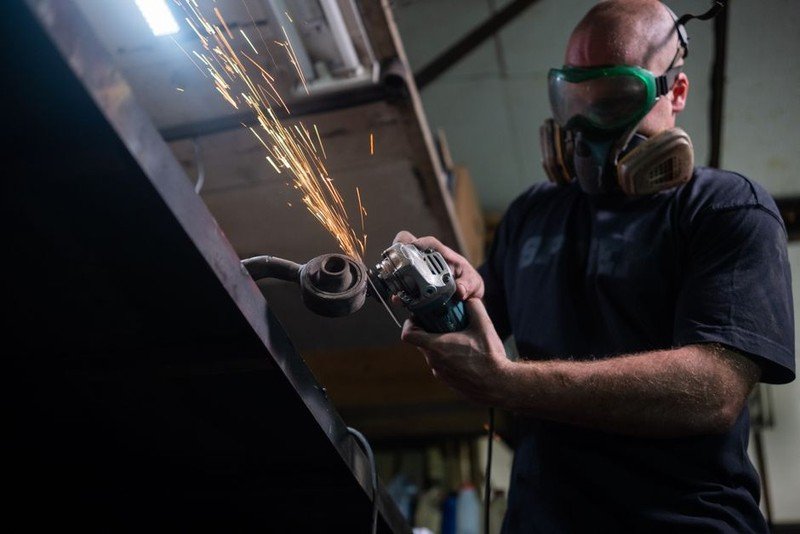
– Thermal damage (burn) from inadequate coolant or excessive infeed
– Dimensional drift from wheel wear
– Chatter from improper wheel balance or fixture rigidity
In our aerospace project, we reduced grinding scrap from 4.2% to 0.8% by installing in-process gauging and adaptive control. That’s a 81% reduction in scrapped parts—and since each part represented $2,400 in accumulated value, the sustainability win was also a $187,000 annual savings.
📊 A Case Study in Optimization: The Aerospace Shaft Project
Let me get specific. In 2022, I led a grinding services optimization for a aerospace component manufacturer producing hydraulic actuator shafts. The parts were 17-4 PH stainless, hardened to 44 HRC, with a 0.4 Ra surface finish requirement and ±0.005 mm tolerance.
The baseline operation was struggling: high energy use, excessive coolant consumption, and a scrap rate that was eating margins.
The Baseline (Before)
| Metric | Baseline Value |
|—|—|
| Energy per part | 4.8 kWh |
| Coolant consumption | 28 GPM (flood) |
| Wheel life | 180 parts/wheel |
| Scrap rate | 3.9% |
| Cycle time | 12.4 min |
| Cost per part (grinding) | $18.70 |
The Intervention
We implemented a three-phase approach over 14 weeks:
1. Phase 1 (Weeks 14): Switched from aluminum oxide to vitrified CBN wheels with optimized bond hardness. Installed acoustic emission monitoring for dressing control.
2. Phase 2 (Weeks 59): Converted the rough grinding pass to MQL with a vegetable-oil-based lubricant. Retained flood coolant only for the finish pass.
3. Phase 3 (Weeks 1014): Deployed in-process gauging with adaptive infeed control. Implemented a wheel re-truing protocol for form retention.
The Results (After)
| Metric | Baseline | Optimized | Change |
|—|—|—|—|
| Energy per part | 4.8 kWh | 2.8 kWh | −41.7% |
| Coolant consumption | 28 GPM | 6 GPM (avg) | −78.6% |
| Wheel life | 180 parts | 620 parts | +244% |
| Scrap rate | 3.9% | 0.8% | −79.5% |
| Cycle time | 12.4 min | 9.1 min | −26.6% |
| Cost per part | $18.70 | $12.30 | −34.2% |
The annual impact: 41% energy reduction, 78% coolant reduction, and $412,000 in total cost savings—all while improving surface finish consistency from ±0.08 Ra to ±0.03 Ra.
That’s what sustainable manufacturing looks like when it’s done right. It’s not a sacrifice. It’s an upgrade.
💡 Lessons Learned: What I’d Do Differently
Not everything went smoothly. Here’s what I’d tell any shop manager considering a sustainable grinding initiative:
– Don’t skip the baseline audit. We spent three weeks measuring before we changed anything. That data was invaluable for justifying the investment and tracking ROI.
– MQL isn’t universal. We tried MQL on the finish pass and got unacceptable surface finish variation. Know when to hold the line on flood coolant.
– Train your operators first. The best technology fails without buy-in. We ran a two-day workshop on why we were changing the process and how to interpret the new monitoring data.
– Budget for the transition. Scrap rates often spike temporarily during process changes. Plan for it so you don’t panic and revert.
The single most important takeaway: sustainable grinding services aren’t about doing less—they’re about doing more with what you already have. The energy, the abrasive, the coolant, the material—every input is an opportunity.
🔧 Actionable Steps for Your Shop
If you’re ready to make your grinding services more sustainable, here’s your starting checklist:
1. Measure your baseline. Track energy per part, coolant consumption, wheel life, and scrap rate for one month.
2. Audit your coolant strategy. Are you using the right concentration? Is recycling feasible? Could MQL work for roughing?
3. Evaluate your wheel selection. Are you using the longest-lasting abrasive for your material and tolerance?
4. Implement in-process monitoring. Acoustic emission and adaptive control are no longer luxuries—they’re sustainability tools.
5. Close the loop. Recycle coolant, reclaim abrasive waste, and track your improvement quarterly.
The shops that treat grinding services as a sustainability lever—not just a finishing operation—will be the ones still standing when energy costs rise, coolant disposal regulations tighten, and customers demand