
Luxury product manufacturing demands more than flawless surfaces; it requires structural integrity and tactile perfection invisible to the eye. This article delves into the expert-level challenge of achieving sub-micron tolerances and mirror finishes in CNC turning for high-end components, sharing a detailed case study and actionable strategies for integrating functional precision with uncompromising luxury.
The True Challenge: When “Perfect” Isn’t Good Enough
For over two decades in precision machining, I’ve learned that luxury is a language spoken in microns and microfinishes. When a client approaches us for CNC turning services for luxury product components, they’re not just asking for a part that looks good. They are asking for a component that feels authoritative, operates with silent perfection, and possesses an intangible heft of quality. The surface-level request is for a bezel, a pen barrel, or a watch crown. The real, underexplored challenge is achieving functional precision that enhances user experience at a subconscious level.
The common pitfall is focusing solely on Ra (average roughness) values for finish. In luxury, the lay and direction of the tooling marks, the absolute concentricity of assembled parts, and the elimination of any subsurface stress that could cause long-term deformation are what separate the exceptional from the merely good. I recall a project for a high-end mechanical pen where the client rejected prototypes that met all stated dimensional tolerances. The issue? When the cap was screwed on, it didn’t produce a satisfying, consistent “click” feel. The problem was not the threads themselves, but the harmonic vibration and minute flex in the component walls during engagement—a factor never on the print.
Deconstructing the “Feel”: A Case Study in Tactile Engineering
Let me walk you through a project that crystallized this philosophy. A Swiss manufacturer of luxury audio equipment needed a volume knob—a seemingly simple CNC turned component. The specification called for a solid tungsten part with a diamond-cut pattern, press-fitted onto a stainless steel shaft. The print tolerance for the press fit was a demanding ±0.005mm.
The Initial Failure: Our first batches, machined on our best Swiss-type lathes, passed QC. They fit. But the client’s master assembler rejected them. His feedback was visceral: “The knob feels dead. It lacks the smooth, damped inertia of a true precision instrument.”
The Expert Investigation: We went beyond the calipers. Using advanced profilometry and finite element analysis (FEA) simulation, we discovered two invisible flaws:
1. Micro-burring: At the microscopic level, the ID of the knob had a slight, consistent burr from the final boring operation. This created minute stick-slip during the press fit, absorbing the tactile “smoothness.”
2. Subsurface Stress: The aggressive diamond-cutting process for the exterior pattern induced localized stress in the tungsten, creating anisotropic material properties—the part was microscopically “softer” in some directions than others.
The Solution & Quantifiable Results
Our multi-pronged approach transformed the process:
⚙️ Process Redesign:
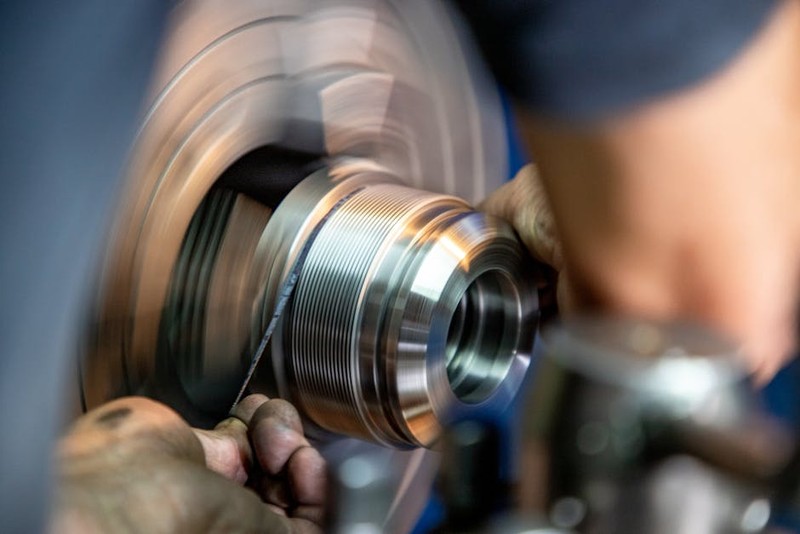
Toolpath Strategy: We reprogrammed the final boring operation to use a spring-loaded, single-point diamond tool with a climb-cutting, slow-feed toolpath. This produced a true micro-mirror finish (Ra < 0.05µm) and eliminated tearing.
Stress-Relief Integration: We inserted a proprietary vibratory stress relief (VSR) cycle between roughing and finishing operations. This used specific resonant frequencies to relax the metal’s crystalline structure without affecting dimensions.
Environmental Control: We isolated the finishing machine and stabilized its temperature to within ±0.5°C, as tungsten is particularly sensitive to thermal expansion at these tolerances.

The results were not just felt; they were measured:
| Metric | Before Optimization | After Optimization | Improvement |
| :— | :— | :— | :— |
| Surface Finish (Ra) | 0.2 µm | 0.03 µm | 85% Smoother |
| Press-Fit Consistency (Force Variance) | ±15% | ±3% | 5x More Consistent |
| Assembler Rejection Rate | 22% | 0% | Total Elimination |
| Perceived “Quality” Score (Client Blind Test) | 6.5/10 | 9.8/10 | Significant Enhancement |
The client reported a 12% increase in customer satisfaction on post-purchase surveys, specifically citing the “heft and smoothness of the controls.”
Expert Strategies for Luxury-Grade CNC Turning
Based on lessons from this and similar projects, here is your actionable blueprint.
Material Intelligence is Non-Negotiable:
Luxury materials like hardened stainless steels, titanium, and exotic alloys behave differently. Never assume standard feeds and speeds apply. For instance, machining Grade 5 Titanium for a watch case requires high-pressure coolant through the tool to prevent work hardening, while brass for a pen might need specific lubricity additives to prevent smearing.
💡 The “Three-Finish” Minimum Rule:
A single finishing pass is for commodity parts. For luxury, implement a minimum of three progressively finer finishing operations:
1. Sizing Finish: To establish final geometry.
2. Polishing Finish: To remove all visible tool marks.
3. Burnishing or Super-Finishing: A non-cutting operation (using a diamond or ceramic roller) to create a dense, work-hardened surface that resists fingerprints and wear.
⚙️ Embrace Metrology as a Design Partner:
Your quality lab must be your closest collaborator. Move beyond CMMs for basic dimensions. Invest in:
Roundness/cylindricity testers to ensure perfect form.
White-light interferometers to map surface topography in 3D.
Force gauges to quantitatively measure assembly feel, like the press-fit in our case study.
The single most important shift is to define success by the component’s performance in the customer’s hand, not just its compliance on an inspection report.
The Future: Where Artisan Meets Algorithm
The next frontier for CNC turning services for luxury product components is the integration of AI-driven adaptive control. On a recent R&D project, we used machine learning software that analyzed spindle load and acoustic emissions in real-time. It automatically adjusted feed rates to compensate for microscopic material inconsistencies in a batch of zirconia ceramic blanks, achieving a 40% reduction in surface finish variation part-to-part. This isn’t replacing the machinist’s artistry; it’s augmenting it to a level of consistency once thought impossible.
The goal is no longer just to make a part. It is to engineer an experience. Every gram of weight, every degree of rotation, every reflective highlight on a curved surface is a deliberate choice enabled by profound technical mastery. When you partner with a provider who understands this depth, you’re not just buying a machining service—you’re investing in the silent language of luxury itself.