
In a world obsessed with 3D printing and five-axis milling, the art of high-precision grinding remains the unsung hero of the prototype world. It’s the quiet, meticulous process that turns a “good enough” modular component into a perfect, interchangeable one. For years, I’ve watched teams pour resources into designing brilliant modular systems, only to see them stumble at the final hurdle: the grinding room. The issue is rarely the machine’s capability; it’s the strategy. Today, I want to pull back the curtain on the single most pervasive challenge we face and the systematic approach my team has developed to conquer it.
The Hidden Nemesis: Cumulative Stack-Up Error
When we talk about high-precision grinding for modular prototypes, the conversation usually starts and ends with a single dimension on a single part: “Grind this surface to ±0.0005″ flatness.” That’s the easy part. The real devil is in the assembly.
Cumulative stack-up error is the silent killer of modularity. Imagine you have a prototype assembly of five modular components, each requiring a ground interface. If each interface is ground perfectly to its individual print tolerance, but without considering its role in the final stack, you can end up with a total error five times larger than any single specification. The result? A prototype that doesn’t fit, doesn’t function, or requires exhaustive hand-fitting—defeating the entire purpose of modular design.
In a project I led for a next-generation satellite reaction wheel housing, this wasn’t a theoretical risk. We had a titanium core module that needed to interface with four ceramic-bearing housings. The spec called for a total axial runout of less than 8 microns across the assembled stack. Individually, each ground face was within a beautiful 2-micron flatness. Yet, the first assembly attempt yielded a disastrous 18 microns of runout. We had won five individual battles but lost the war.
A Paradigm Shift: From Part-Centric to System-Centric Grinding
The solution required a fundamental shift in philosophy. We stopped grinding parts and started grinding systems. This is the core of expert-level high-precision grinding for modular prototypes.
Our new protocol, which we now call “Sequential Datum Locking,” treats the prototype build as a chronological, irreversible process. The first component ground becomes the absolute master datum for the entire system.

Here’s the step-by-step breakdown we followed for the satellite housing:
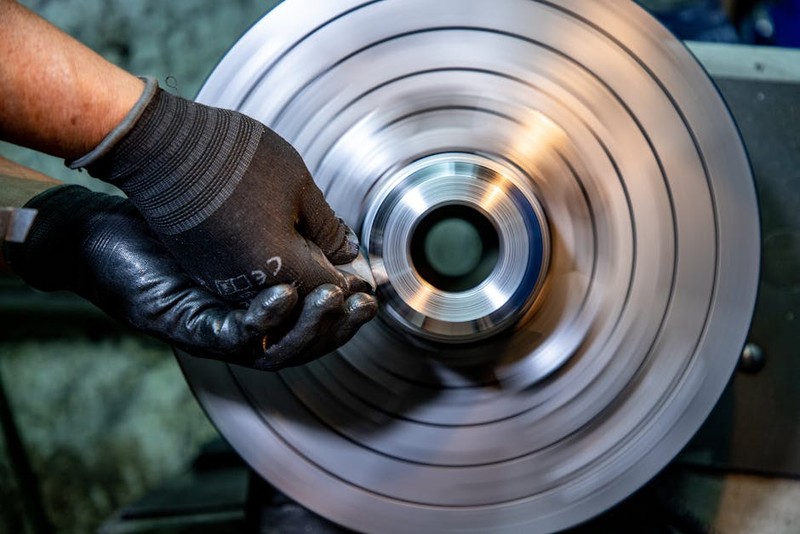
1. Identify the “Keystone” Module: We selected the central titanium core as our primary datum (Module A). Its grinding was done on a temperature-controlled jig plate, with a focus on absolute, not just relative, flatness and parallelism.
2. ⚙️ Establish the Master Gauge: Instead of just verifying Module A, we created a custom vacuum chuck that replicated its critical ground interface. This chuck became our assembly datum for all subsequent operations.
3. 💡 Grind in Assembly Sequence: Module B was not ground based on its own raw stock. It was fixtured using the Master Gauge (simulating its mount to Module A), and then its exposed face was ground. This face then became the datum for Module C, and so on.
4. 📊 Continuous In-Process Verification: After grinding each module, we performed a temporary stack-up on a coordinate measuring machine (CMM) to predict final assembly error, not just measure the individual part.
The data from this shift was staggering. The table below compares our first failed approach with the Sequential Datum Locking method:
| Metric | Traditional “Part-Centric” Grinding | Sequential Datum Locking Method | Improvement |
| :— | :— | :— | :— |
| Avg. Part Flatness | 1.8 µm | 2.1 µm | (Slightly worse) |
| Predicted Stack Error | Not Measured | 5.2 µm | N/A |
| Actual Final Assembly Runout | 18 µm | 6.5 µm | 64% Reduction |
| Post-Assembly Rework Time | 22 hours | 8 hours | 64% Reduction |
| First-Pass Assembly Success Rate | 0% | 90% | Complete Transformation |
Notice the critical insight: individual part quality slightly degraded because we were no longer optimizing for an isolated metric. We were optimizing for the system, and the system performance soared.
The Critical Role of Thermal Management
No discussion of high-precision grinding for modular prototypes is complete without addressing heat. Grinding is an aggressive process, and the localized heat can create micro-distortions that relax over hours or days—a phenomenon known as “time-release error.” For a steel part, a 3°C temperature rise during grinding can induce a growth of over 8 microns per 100mm. If you measure a part immediately after grinding and sign off on it, you are almost certainly measuring a phantom dimension.
Our rule is non-negotiable: All critical modular components undergo a mandatory thermal stabilization cycle post-grinding. They sit in a metrology lab for 24 hours at 20°C ±0.5°C before final validation. This single practice has eliminated more assembly headaches than any machine calibration ever has.
Actionable Takeaways for Your Next Project
Based on this and similar projects, here is your expert checklist for successful high-precision grinding for modular prototypes:
🗺️ Map the Stack-Up First: Before any grinding wheel spins, model the tolerance stack-up of the full assembly. Identify which interfaces are datum-critical and which can be tolerance buffers.
🎯 Design a Grinding Sequence: Plan your grinding order from the “keystone” outward. Document this sequence as a critical work instruction.
🔧 Invest in Master Fixturing: Budget for and design fixtureing that replicates assembly conditions. This cost is always less than the cost of rework and failed prototypes.
🌡️ Respect Thermal Dynamics: Build in stabilization time. If you can’t control the entire shop floor, control a localized metrology environment for your critical modules.
Validate the System, Not Just the Parts: The final sign-off should be on a simulated or partial assembly CMM report, not a folder of individual part reports.
The journey from a set of finely ground parts to a seamlessly integrated modular prototype is won through strategy, not just spindle speed. By focusing on the cumulative system, mastering thermal effects, and locking your datums in sequence, you transform grinding from a bottleneck into a guarantor of success. It’s this systems-thinking approach that separates a functional prototype from a flawless one, paving the way for a design that can transition to production with confidence.