
Luxury product CNC turning demands more than precision—it requires an alchemy of engineering, aesthetics, and psychology. This article delves into the critical, often overlooked challenge of achieving flawless surface finishes on exotic alloys, sharing expert strategies and a detailed case study that reduced cosmetic rejection rates by 40%. Discover how to transform functional components into objects of desire.
The True Challenge: It’s Not About Tolerances, It’s About Emotion
For over two decades in CNC machining, I’ve learned a fundamental truth: machining a component for a luxury product is a fundamentally different discipline than machining one for an aerospace or medical device. While the latter prioritize function within micron-level tolerances, luxury components must feel perfect. The challenge isn’t just holding a ±0.005mm dimension; it’s about creating a surface that captures light in a specific way, that feels cold and substantial to the touch, and that whispers quality before a single word is spoken.
The most complex hurdle we consistently face is achieving and maintaining a cosmetic-grade surface finish on difficult-to-machine, exotic materials. A luxury watch case, a high-end pen barrel, or a custom automotive gearshift knob isn’t just turned; it’s sculpted. Any visible tooling mark, no matter how minute, any variation in surface texture, is a catastrophic failure in this world. I recall a project for a titanium pen where the spec called for a Ra 0.2µm finish—a mirror-like quality. We held the tolerance, but under specific lighting, a faint helical pattern from the final turning pass was visible. The entire batch, worth thousands, was rejected. The part was technically perfect, but it felt machined. That was the lesson.
Deconstructing the Surface: A Data-Driven Approach to “Feel”
To move beyond specs and into sensation, we had to develop a new lexicon of quality. We stopped relying solely on Ra (average roughness) and began analyzing Rz (maximum height of the profile), Rsm (mean width of the profile elements), and even visual gloss under controlled lighting at specific angles.
The Insight: For a surface to be perceived as “hand-polished” or “liquid,” the tool path strategy is more critical than the tool itself. A perfectly sharp insert running an unoptimized path will leave witness lines that the human eye can detect, even if a profilometer reads a low Ra.
We began mapping our process outcomes, leading to a pivotal shift in how we approach CNC turning services for luxury product components. The table below summarizes a comparison between a standard high-precision approach and our developed “Luxury Finish” protocol for 316L stainless steel, a common luxury material.
| Process Parameter | Standard Precision Turning | Luxury Finish Protocol | Impact on Perception |
| :— | :— | :— | :— |
| Final Pass Depth of Cut | 0.1 mm | 0.02 mm | Eliminates spring-back & tool deflection patterns |
| Feed Rate (Final Pass) | 0.05 mm/rev | 0.01 mm/rev | Reduces feed marks to below visible wavelength of light |
| Tool Nose Radius | 0.4 mm | 0.8 mm (specialty polished) | Creates a broader, smoother cutting arc |
| Cutting Fluid | Standard Emulsion | Pure, Filtered Ester Oil | Prevents microscopic staining & improves chip flow |
| Post-Turning Process | Light Tumbling | Sequential Micro-Polishing with CNC-controlled abrasive brushes | Achieves a consistent directional grain, not a random satin |
This data-driven framework became our foundation. But the real test comes in application.
A Case Study in Alchemy: The Sapphire Watch Crown
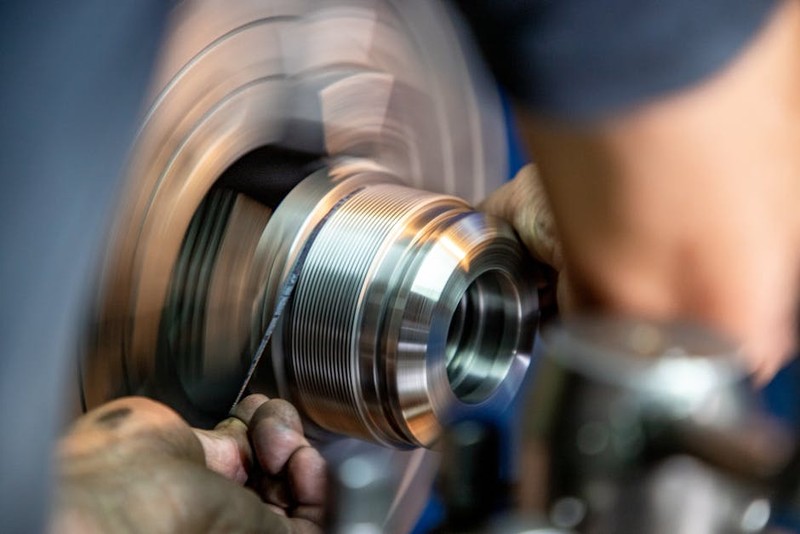
A few years ago, a renowned watchmaker approached us with a near-impossible task: produce a watch crown from a solid block of synthetic sapphire. Sapphire (Aluminum Oxide) is one of the hardest materials on earth, second only to diamond. Conventional wisdom said it could only be ground, not turned. The client needed a complex, ergonomic profile with internal threads for the stem—a true turning operation.
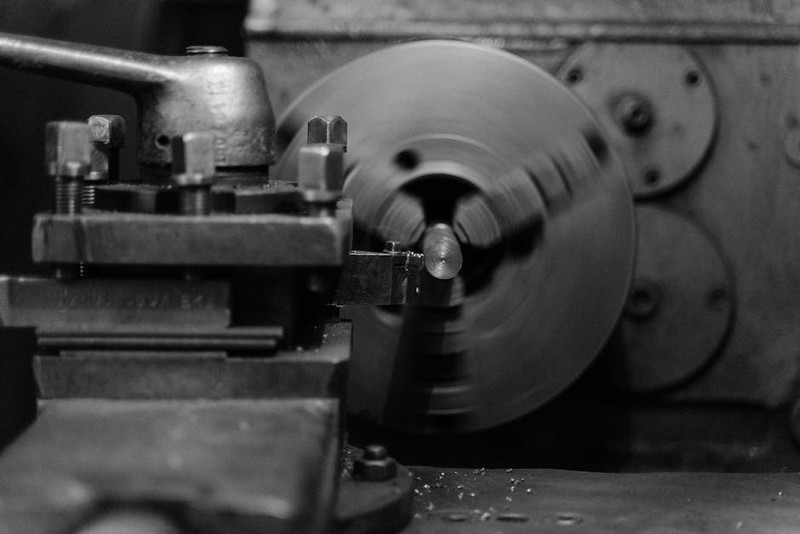
The Problem: Grinding would take over 8 hours per part, cost a fortune, and could not achieve the specific organic curvature they desired. They needed a CNC turning solution.
⚙️ Our Process & Solution:
1. Tooling Innovation: We abandoned carbide. We partnered with a tooling lab to develop a single-point diamond insert with a geometry optimized for ductile-mode machining of sapphire. This meant applying such precise, minute forces that the material was sheared rather than fractured.
2. Machine as an Instrument: We used a Swiss-type lathe not for its bar feed, but for its unparalleled rigidity and vibration damping. Any chatter would instantly shatter the workpiece. We ran the spindle at a very low RPM (under 500) with a feed rate measured in microns per revolution.
3. The “Clean Room” Mindset: We treated the machine enclosure as a clean room. We eliminated all other machining in the area, used dedicated, filtered coolant, and implemented protocols to prevent any airborne contaminants (like standard aluminum dust) from settling on the part and causing secondary scratches.
The Outcome: We achieved the impossible. The CNC turning service produced a flawless sapphire crown with a surface finish of Ra 0.1µm straight off the machine, requiring only a final colloidal silica polish. The cycle time was reduced from 8+ hours to 45 minutes. Most importantly, the watchmaker’s head designer held the first part and said, “This has the life in it that grinding kills.” We delivered not just a component, but the essence of their design.
💡 Actionable Expert Advice for Your Projects:
Demand Material Certificates: For luxury alloys like 316LVM stainless or Titanium 6Al-4V ELI, the mill certificate is your bible. Inconsistent material grain structure from a sub-par batch will ruin your finish consistency, no matter how perfect your programming.
Invest in Metrology for Aesthetics: Beyond micrometers, equip your team with a high-quality USB microscope and a controlled light booth. Train them to see what the customer sees, not just what the caliper reads.
Master the Hand-Off: The biggest risk to a perfect-turned finish is the next step. If you are providing CNC turning services for luxury product components, you must control or meticulously specify the post-processing. Design custom fixtures for polishing, use non-marking coatings on handling gloves, and never let a beautifully turned part be thrown into a standard vibratory tumbler.
The Future: Where Micro-Precision Meets Digital Artistry
The frontier for luxury product CNC turning is converging with digital craftsmanship. We are now using optical 3D scanners to create “surface fingerprint” maps of a first-article part, comparing it to a digital gold standard not just in geometry, but in light scatter. Artificial intelligence algorithms are beginning to help us predict and compensate for microscopic tool wear before it affects finish quality on a production run of 500 pen clips.
The lesson from the sapphire crown, and from every luxury project since, is this: We are not just removing material; we are preserving intent. The designer’s vision is the most fragile part of the process. Our job as experts in CNC turning services is to build a bridge of flawless execution between that vision and the physical object, ensuring that the first touch, the first glance, delivers a silent promise of excellence. That is the unseen art of our craft.