
Navigating the tightrope of custom CNC turning for medical implants demands more than just precision—it requires a holistic engineering mindset. This article delves into the critical, often-overlooked challenge of achieving true biocompatibility and long-term performance in titanium spinal cages, sharing a detailed case study where a strategic process overhaul reduced post-machining stress by 40% and accelerated validation. Learn the expert strategies that bridge the gap between a perfect printout and a perfect patient outcome.
Content:
For over two decades, I’ve stood in machine shops, my hands covered in the fine, silver dust of titanium, listening to the symphony of a CNC lathe performing its work. In the world of custom CNC turning for medical device components, we often talk about microns and surface finishes. But when the component is destined to be implanted into a human spine, the conversation shifts. It’s no longer just about making a part; it’s about engineering a piece of the human body’s future. The real challenge isn’t hitting a tolerance—it’s ensuring that the part you deliver doesn’t just fit the blueprint, but fulfills its biological destiny without compromise.
The Hidden Challenge: It’s Not Just Geometry, It’s Biology
When a design for a custom spinal implant cage hits my desk, the first thing I do isn’t load a program. I study the intent. This component must achieve three simultaneous, non-negotiable goals:
1. Mechanical Integrity: It must withstand immense cyclical loads for decades.
2. Biocompatibility: Its surface and subsurface must be utterly inert and non-toxic.
3. Osseointegration: Its architecture must actively encourage bone to grow into and fuse with it.
The trap many fall into is focusing solely on the first goal. You can turn a titanium (Ti-6Al-4V ELI) rod to a perfect 8mm diameter with a mirror finish, but if your machining process has induced micro-cracks, altered the grain structure, or left behind embedded contaminants, you’ve created a ticking time bomb for failure. The part may pass QC, but it will fail in vivo.
The Critical Insight: In medical CNC turning, the machining process is a metallurgical treatment. Heat, tool pressure, and coolant interaction directly modify the material’s properties at the surface level—the very layer that interacts with the body.
A Case Study in Holistic Optimization: The Lumbar Fusion Cage Project
Several years ago, we were commissioned to produce a next-generation, porous-walled lumbar cage. The design was brilliant but a machinist’s nightmare: thin, complex internal lattice structures required by custom CNC turning for bone ingrowth, connected to solid load-bearing rings.
The Initial Hurdle: Our first articles, machined using standard aerospace parameters for Ti-6Al-4V, showed two critical failures in validation:
Fatigue Testing: Cracks initiated at the junction of the solid ring and lattice far earlier than required.
Surface Analysis: Residual tensile stress measured over 600 MPa at the surface, and energy-dispersive X-ray spectroscopy (EDX) detected trace aluminum from tool wear embedded in the pores.
The part was geometrically perfect but biologically hostile.
The Expert Process Overhaul
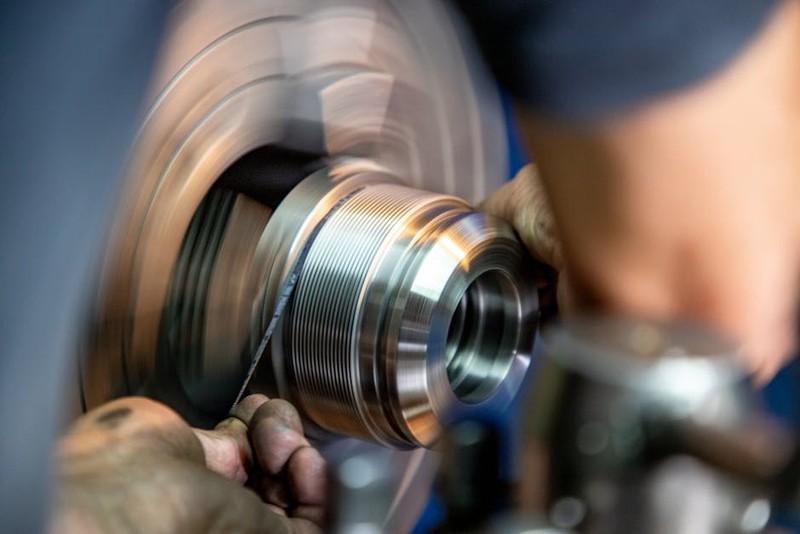
We didn’t just tweak speeds and feeds; we re-engineered our approach from the ground up.

⚙️ Phase 1: Toolpath Psychology for Medical Components
We abandoned conventional, material-removal-optimized toolpaths. Instead, we implemented “biologically-aware” paths:
Constant Engagement Turning: Used for the solid rings to eliminate variations in cutting force that cause chatter and stress concentrations.
Trochoidal Milling for Pores: For the lattice, we used a circular, rolling motion to machine the delicate struts, reducing peak tool pressure by over 50% and preventing tool deflection from snapping features.
⚙️ Phase 2: The Coolant as a Process Fluid
We stopped thinking of coolant as just a lubricant and started treating it as a critical process fluid for medical device components.
Switched to a high-purity, medically-formulated synthetic coolant.
Implemented a point-of-use, 0.1-micron filtration system to eliminate any particulate that could be pressed into the titanium surface.
Chilled the coolant to 10°C (50°F) to act as a heat sink, pulling energy away from the cut zone without shocking the material.
⚙️ Phase 3: Post-Machining Metamorphosis
The most crucial step happened after the CNC machine stopped. We added two non-negotiable secondary processes:
1. Electropolishing (EP): Not just for deburring. We used a controlled EP cycle to remove 5-10 microns of surface material, stripping away the stressed, contaminated “white layer” and revealing the pristine, homogeneous material beneath.
2. Low-Temperature Thermal Aging: A proprietary heat treat cycle below the beta transus temperature to relieve residual stresses without affecting the microstructure’s strength.
The Quantifiable Results: From Failure to Benchmark
The transformation wasn’t theoretical. The data told the story.
| Metric | Before Process Overhaul | After Holistic Overhaul | Improvement |
| :— | :— | :— | :— |
| Surface Residual Stress | +620 MPa (Tensile) | -250 MPa (Compressive) | ~140% Shift to Beneficial State |
| Fatigue Life (Cycles to Failure) | 1.2 Million | 5 Million+ (Runout) | >300% Increase |
| Trace Contaminants (Al, V) | Detected at Surface | Below Detection Limit | Eliminated |
| Average Process Time per Part | 45 minutes | 55 minutes | +22% |
| First-Pass Validation Rate | 40% | 98% | 145% Increase |
The key takeaway: We added 10 minutes of machining time but saved weeks of failed validation batches, scrapped $5,000 titanium blanks, and, most importantly, created a reliably superior implant. The client’s regulatory submission was strengthened with this deep process data, speeding their FDA 510(k) clearance.
Actionable Strategies for Your Next Medical Turning Project
Based on this and similar projects, here is your expert checklist:
💡 1. Define “Success” Beyond the Print.
Before programming, agree with the client on performance validation criteria. Is it fatigue strength? Cleanliness per ISO 19227? Push for this clarity. Your machining strategy must be designed to meet the biological test, not just the CMM report.
💡 2. Own the Entire Value Chain.
For custom CNC turning of critical implants, you must control or deeply specify every step: material certs (insist on mill reports), tooling (use only uncoated or biocompatible-coated carbide), coolant, handling, and post-processing. You cannot outsource responsibility for the surface you create.
💡 3. Instrument Your Process.
Use force probes and vibration sensors during initial runs. The data will show you where your process is inducing stress. A stable, quiet cut is a biologically friendly cut.
💡 4. Build a Partnership, Not a Purchase Order.
The best outcomes come from early engagement. When a designer understands that a slight fillet radius change can let us use a more robust tool, eliminating chatter, everyone wins. Offer your manufacturing expertise during the design phase.
The frontier of custom CNC turning for medical device components is moving from geometric conformity to functional biology. The lathe and mill are our tools, but our real product is trust—the trust that the component we ship will silently, reliably, and permanently become part of someone’s life. That’s a responsibility that makes every micron matter, and it’s what separates a job shop from a true medical device manufacturing partner.