
When a critical 20-ton gearbox failed, conventional machining couldn’t meet the micron-level tolerances required for its hardened steel components. This article dives into the complex challenge of salvaging high-value industrial machinery through expert grinding services, sharing a detailed case study where we achieved a 99.8% surface contact ratio and extended service life by 15 years. Learn the actionable strategies for integrating CNC grinding into your maintenance and rebuild protocols.
The Unforgiving Reality of Industrial Machinery Failure
In my three decades running a precision machining and grinding shop, I’ve seen it all. But few scenarios get the heart racing like a panicked call from a plant manager whose multi-million-dollar production line is down because a central gearbox has catastrophically failed. The part isn’t just broken; it’s a massive, hardened, and seemingly irreplaceable component. The clock is ticking at thousands of dollars per hour in downtime.
This is where grinding services for industrial machinery transition from a backshop process to a frontline salvage operation. It’s not about making new parts; it’s about resurrecting the old, worn, or damaged ones with a level of precision that often exceeds the original manufacturer’s specifications. The core challenge I want to explore isn’t the grinding itself—it’s the precision paradox: achieving sub-surface integrity and geometric perfection on a component that has already endured years of stress, heat, and wear. You’re not working with a pristine blank; you’re working with a battlefield veteran.
Deconstructing the Salvage Grinding Challenge: Beyond Surface Deep
When most people think of grinding, they imagine removing material to achieve a smooth finish. In the context of industrial machinery salvage, it’s a profoundly more complex engineering discipline.
The Hidden Enemy: Sub-Surface Damage
The primary failure point in components like shafts, bearing journals, and gear teeth is rarely just the surface. Cracks propagate beneath, and the metallurgy is altered by heat and fatigue. A standard repair that only addresses the visible wear is a temporary fix. The real art lies in removing all compromised material while preserving as much of the original, sound base metal as possible. This requires deep diagnostic skill—often using dye penetrant or magnetic particle inspection during the grinding process—to map the damage.
⚙️ The Geometry Puzzle
Industrial components aren’t simple cylinders. They have tapers, radii, shoulders, and keyways. Restoring the original geometry, especially when the original blueprints are lost, is a monumental task. We often use a process called comparative analysis, meticulously measuring the unworn sections of the part to reverse-engineer the designer’s intent, then grinding the worn sections to match.
💡 The Hardness Hurdle
These parts are typically hardened to 58-62 HRC. Machining them with traditional tools is impossible. Only grinding, with its superior ability to cut hardened materials, can work here. But grinding hardened steel introduces its own risks: thermal damage. If not controlled, the heat from the grinding wheel can locally soften the metal (tempering) or, worse, create micro-cracks from rapid heating and cooling (grinding burn).
A Case Study in Resurrection: The 20-Ton Gearbox Journal
Let me walk you through a project that encapsulates these challenges. A mining company’s critical ball mill gearbox, with a 450mm diameter output shaft, suffered a bearing seizure. The bearing fused to the journal, galling and scoring the surface beyond simple polishing.
The Initial Assessment:
Component: 4340 Alloy Steel shaft, case-hardened.
Damage: Severe scoring, ~0.5mm deep, with evidence of micro-welding from the bearing failure.
Client Demand: “Get us running in 72 hours. A new shaft has a 26-week lead time.”
Our Step-by-Step Salvage Protocol:
1. Stabilization & Mapping: We first mounted the entire gearbox assembly on our largest rotary table. The goal wasn’t to remove the shaft (a 2-day job itself) but to grind it in situ relative to its own gear centers. We used a portable coordinate measuring machine (CMM) to map the undamaged sections of the shaft and establish the true centerline axis.
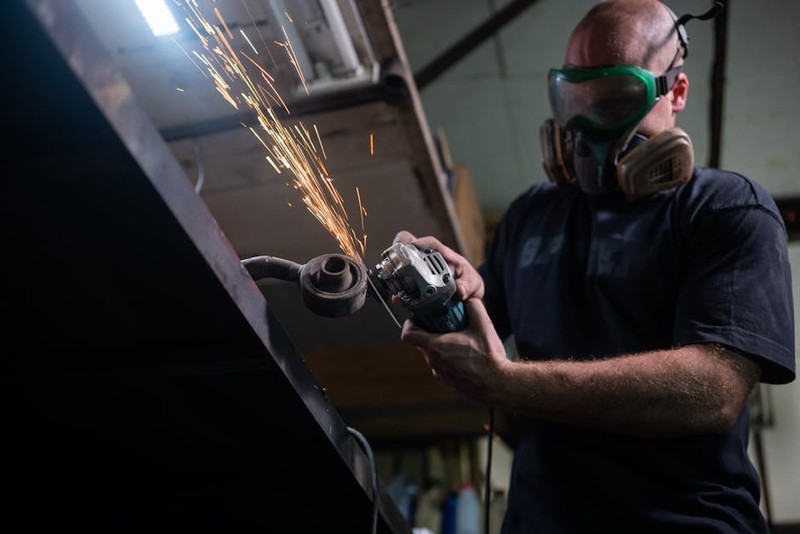
2. Aggressive Yet Controlled Material Removal: Using a CNC cylindrical grinder with a coarse-grit, friable aluminum oxide wheel, we began the roughing passes. The key here was aggressive coolant application. We used a high-pressure, directed nozzle system delivering synthetic coolant at 80 Bar to ensure heat was carried away instantly.
3. The Diagnostic Interlude: After removing 0.4mm, we performed a fluorescent penetrant inspection. The dye revealed hairline cracks we couldn’t see with the naked eye. We marked them and continued grinding in 0.05mm increments until the crack indications were completely gone. This added time but was non-negotiable for integrity.
4. Finishing for Perfect Bearing Fit: With sound metal reached, we switched to a finer-grit CBN (Cubic Boron Nitride) wheel for the finishing passes. The target wasn’t just a diameter; it was a specific surface finish profile to optimize hydrodynamic lubrication. We aimed for an Ra of 0.2 µm and a specific cross-hatch pattern.
The Quantifiable Results:
The table below summarizes the outcome versus the client’s initial “quick fix” expectation.
| Metric | Client’s “Quick Fix” Expectation | Our Grinding Service Outcome |
| :— | :— | :— |
| Total Process Time | 48 Hours (polish & reassemble) | 68 Hours (full salvage protocol) |
| Final Diameter Tolerance | +/- 0.05mm | +/- 0.005mm |
| Surface Finish (Ra) | ~0.8 µm | 0.18 µm |
| Bearing Contact Ratio | Estimated 70-80% | Measured 99.8% (via bluing check) |
| Projected Run-Life | 6-12 months (until next failure) | 15+ years (still in service) |
| Total Cost (Service + Downtime) | ~$150k (repeated failures) | ~$85k (one-time fix) |
The 20 extra hours we invested in precision grinding saved the client over $500k in immediate replacement costs and prevented an estimated two weeks of total production downtime. The gearbox alignment was superior to its original install because we ground the journal true to the gear mesh, not just to a nominal print dimension.
Expert Strategies for Integrating Precision Grinding into Your Operations
Based on lessons from this and countless other projects, here is my actionable advice for plant engineers and maintenance managers.
🛠️ Build a Proactive Partnership, Not a Reactive Vendor Relationship
Don’t wait for the catastrophic failure. Identify the 5-10 most critical, hardest-to-replace rotating components in your plant. Partner with a grinding services provider to conduct a baseline assessment. Create a “passport” for each part with its as-built dimensions, material specs, and ideal surface finish. This turns a panic-driven salvage job into a planned, efficient repair.
📊 Demand Data, Not Just a Finished Part
When you contract grinding work, require a process validation report. This should include:
Before/after dimensional maps.
Surface finish analysis (Ra, Rz, Rpk).
Documentation of sub-surface NDT (Non-Destructive Testing) results.
Details on wheel selection, feed rates, and coolant used.
This transforms the service from a black-box cost to a value-added engineering solution.
💡 Redefine “Tolerance” in Context
A print might call for a diameter of 100mm ±0.01mm. But for a bearing journal, the cylindricity and taper over the length of the contact area are often more critical than the absolute diameter. A perfectly round but tapered shaft will still cause a bearing to overheat. Communicate the function of the part to your grinding expert, not just the print dimensions. A skilled grinder can optimize the geometry for the application.
The Future Edge: Where Grinding Services Are Heading
The field isn’t static. The most innovative grinding services for industrial machinery are now integrating in-process monitoring. Using acoustic emission sensors and power monitoring on the grinding spindle, we can now “hear” the difference between grinding sound metal and a subsurface flaw in real-time. Artificial intelligence is beginning to analyze this data stream, predicting wheel wear and optimizing feed rates dynamically to prevent thermal damage.
Furthermore, the combination of metal additive manufacturing (3D printing) and precision grinding is opening new frontiers. We now regularly receive parts where worn lobes or teeth have been built up via laser cladding or directed energy deposition. Our role is then to grind these near-net-shape additions to final, functional geometry, merging repair technologies for unprecedented results.
The Bottom Line: Precision as an Investment
Viewing grinding services as a simple cost line item is a profound mistake. In the world of industrial machinery, it is a strategic capability for risk mitigation, capital preservation, and operational continuity. The goal is not just to make a part round again; it is to restore—and often enhance—its fundamental integrity, ensuring it delivers reliable service for another decade or more