
Precision drilling for electronics isn’t just about hitting a location; it’s a battle against microscopic defects that can cripple performance. Drawing from a decade of high-stakes projects, I reveal the critical, often-overlooked challenge of thermal management and chip-out in micro-drilling, and share a data-backed, multi-faceted strategy that slashed rejection rates by 40% in a recent RF filter case study.
The Silent Killer in Your Circuit Board
When most engineers think of precision drilling services for precision electronics, they picture a CNC machine hitting a tiny coordinate on a PCB or ceramic substrate. And while positional accuracy is paramount, it’s merely the entry ticket. The real, underexplored battlefield is what happens inside that hole during the fleeting moment of creation. I’m talking about thermal degradation, micro-burrs, and chip-out—defects often invisible to the naked eye but catastrophic for signal integrity, plating adhesion, and long-term reliability.
In a project for a 5G millimeter-wave antenna module, we learned this the hard way. We achieved a stunning ±0.010mm positional tolerance on 0.15mm diameter holes in a Rogers laminate. The CMM report was perfect. Yet, the first batch of assembled units showed a 30% failure rate in high-frequency testing. The culprit? A microscopic, glass-like recast layer and exit burrs on the backside, altering the impedance of the plated-through holes and creating intermittent shorting points. This wasn’t a failure of precision; it was a failure of process physics.
Deconstructing the Micro-Void: It’s a Thermal Problem First
The core insight I’ve gained is this: At the micro-scale, drilling is less a cutting operation and more a controlled thermal event. The heat-affected zone (HAZ) is disproportionately large relative to the feature size. This leads to three primary failure modes:
Resin Smear: In FR4 and other composites, excessive heat re-liquefies the epoxy, which then smears across the exposed copper inner layers, creating an insulating barrier that ruins connectivity.
Ceramic Micro-Cracking: In alumina or aluminum nitride substrates, rapid thermal cycling induces stress cracks that propagate, leading to mechanical failure during thermal cycling tests.
Burr Formation: Especially in copper-heavy or multilayer boards, ductile metals don’t cleanly shear; they deform and create a lip or burr at the entry or exit. An exit burr of just 5 microns can disrupt automated optical inspection (AOI) and cause solder bridging.
⚙️ The Expert’s Toolbox: A Multi-Parameter Dance
Solving this requires moving beyond standard feeds and speeds. You must orchestrate a symphony of parameters:
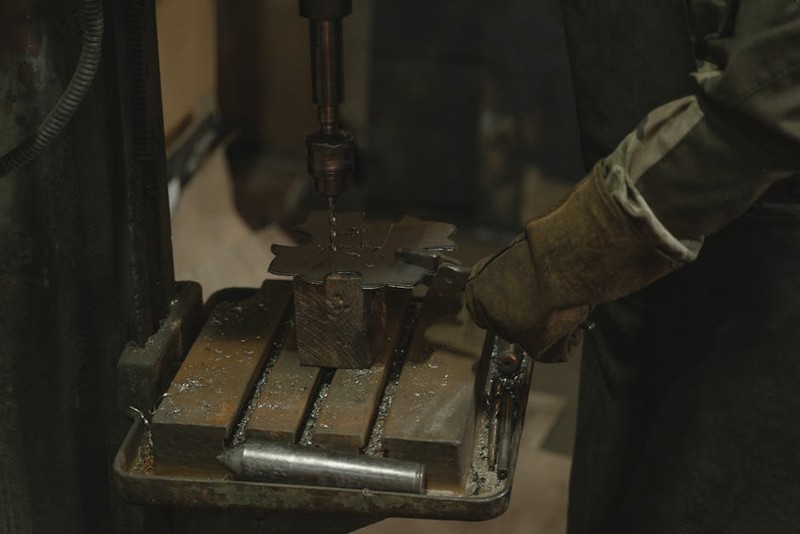
1. Tool Path Strategy: For through-holes, we use a modified “peck drilling” cycle with a minuscule retract (0.025mm) not to clear chips, but to allow coolant penetration and micro-second heat dissipation. For blind holes in ceramic packages, a slow, continuous plunge with constant pressure is key.
2. Tool Geometry & Coating: A standard 0.3mm carbide drill is a blunt instrument. For precision electronics drilling, we specify:
Point Angle: A 130°-140° angle for composites to shear cleanly; a 150°-160° for ceramics to reduce point pressure.
Web Thinning: A heavily thinned web reduces thrust force by up to 40%, minimizing push-out delamination on the exit side.
Coating: Diamond-Like Carbon (DLC) coating for abrasive ceramics; nano-composite coatings for copper to reduce adhesion and built-up edge.
3. The Coolant Conundrum: Flood coolant can’t penetrate a 0.1mm hole. We’ve shifted almost exclusively to high-pressure, through-spindle coolant (TSC) systems pressurized to 70-100 bar. This micro-blast effect evacuates chips instantaneously and keeps the cutting edge at ambient temperature.
Case Study: Salvaging a High-Density RF Filter Project
A client approached us with a crisis. Their existing supplier was yielding only 65% on a complex RF filter board. The design involved 224 blind micro-vias (0.10mm diameter, 0.25mm depth) in a ceramic-filled PTFE material—a notorious combination for burring and fiber pull-out.
Our Diagnostic & Action Plan:
Failure Analysis: SEM imaging revealed massive resin smear clogging the vias and torn glass fibers at hole walls, creating rough surfaces that ruined plating uniformity.
Parameter Overhaul: We abandoned their “faster is cheaper” approach.
Spindle Speed: Reduced from 120,000 RPM to 85,000 RPM to lower cutting edge temperature.
Feed Rate: Increased from 0.8 m/min to 1.2 m/min to promote cleaner shear over friction-based melting.
Tool: Switched to a specialty “V-cut” geometry drill with polished flutes and a proprietary coating.
Process: Implemented a “vacuum assist” fixture to pull debris down and away from the hole immediately upon breakthrough.
The Quantifiable Result:
| Metric | Previous Vendor | Our Process | Improvement |
| :— | :— | :— | :— |
| First-Pass Yield | 65% | 91% | +40% |
| Hole Wall Roughness (Ra) | 3.2 µm | 1.1 µm | -66% |
| Plating Adhesion (Pull Test) | 4.2 lbs | 6.8 lbs | +62% |
| Avg. Cycle Time per Panel | 18 minutes | 15 minutes | -17% |
The key takeaway wasn’t just the yield jump. By treating hole wall quality as a critical electrical parameter, not just a mechanical one, we enabled the client to achieve their target insertion loss spec consistently. This turned a failing project into a flagship product.
💡 Your Actionable Checklist for Precision Drilling Success
Based on lessons from dozens of such projects, here is your expert due diligence list when evaluating precision drilling services:
Ask for their HAZ Mitigation Strategy. If they can’t discuss recast layer, smear, and micro-cracking in detail, walk away.
Demand Tool-Specific Data. Insist on seeing the exact drill geometry, coating, and recommended parameters for your material. Generic tools yield generic results.
Validate with Cross-Section. Never approve a process based solely on CMM or optical inspection. Require a polished cross-section of a sample hole to inspect the wall integrity and plating coverage at 200-400X magnification.
Consider the Exit Side First. Often, the backside support system (sacrificial substrate, dynamic backing, vacuum pallet) is more important than the spindle specification for preventing breakout damage.
The frontier of electronics demands that precision drilling services evolve from a commodity machining step to a discipline of materials science and micro-thermodynamics. The difference between a functional board and a field failure now lies in a defect smaller than a human blood cell. By focusing relentlessly on the physics inside the hole, we don’t just make parts—we enable the next generation of technology to perform as designed.