
Luxury product CNC milling transcends mere dimensional accuracy; it’s a discipline of material psychology and surface alchemy. This article delves into the expert-level challenge of achieving flawless, tactile perfection in high-end metals, sharing a proprietary multi-stage finishing protocol and a case study that reduced visual defect rates by 99.5%. Learn the strategies that separate premium machining from the merely precise.
For two decades, I’ve operated in the rarefied air where machining meets artistry. Clients don’t come to us with blueprints; they come with visions—a watch case that must feel like cold silk, a pen barrel with a heft that whispers quality, a surgical instrument that earns a surgeon’s trust before the first incision. The common thread? An uncompromising demand for perfection that standard CNC milling services simply cannot fulfill. This isn’t about holding a tolerance of ±0.005″; it’s about mastering the intangible: the play of light on a surface, the silent operation of moving parts, the emotional response evoked by an object’s touch.
The real work begins where the CAD model ends.
The Hidden Challenge: Surface Integrity as the True Benchmark
Most engineering specs focus on geometry. In luxury, the spec sheet is a feeling. The paramount, often underexplored, challenge is surface and sub-surface integrity. When you mill a block of 316L stainless steel or 6Al-4V titanium for a high-end product, you are not just shaping it; you are altering its very structure at a microscopic level.
The Problem Beneath the Shine: Aggressive machining parameters—high feed rates, deep cuts, improper toolpaths—create a work-hardened, stressed “skin” on the metal. This layer, often only microns deep, is a ticking time bomb. It can lead to:
Orange Peel Effect: After polishing, the stressed layer relaxes unevenly, creating a wavy, dimpled texture that destroys a mirror finish.
Premature Corrosion: Stressed grains are electrochemically more active, making even “stainless” steels susceptible to subtle pitting or discoloration over time.
Fracture Initiation: In components subject to load, like a folding knife’s pivot or a watch’s crown stem, this layer can be the origin point for failure.
I learned this the hard way early in my career. We delivered a batch of aerospace-grade titanium components for a luxury pen maker. They passed every CMM check. Yet, after the client’s in-house polishing, faint, ghost-like swirls appeared under certain lighting. The entire batch was rejected. The cost was astronomical, but the lesson was priceless: In luxury CNC milling, the quality is not just in the dimensions you measure, but in the structure you create.
A Proprietary Protocol: The Multi-Stage Path to Perfection
Solving this requires moving from a machining operation to a holistic process. We developed an internal protocol we call “Progressive Surface Genesis.” It’s a philosophy that governs every step from raw material to final deburring.
⚙️ Phase 1: Strategic Roughing & Stress Management
The goal here is not speed, but stewardship. We treat the initial roughing passes as a way to manage internal stress, not just remove material.
Toolpath Intelligence: We employ trochoidal and peel milling strategies for roughing. These constant-engagement paths reduce localized heat and vibration, preventing that hardened skin from forming.
The 30% Rule: For critical surfaces, we never remove more than 30% of the remaining stock in the semi-finishing pass. This gradual approach minimizes the re-introduction of stress.
Data-Driven Tool Selection: We don’t just pick an end mill from a catalog. We match substrate (e.g., micro-grain carbide), coating (AlTiN for aluminum, diamond-like carbon for plastics), and geometry to the specific alloy’s behavior. The table below shows the impact on a common luxury material:
| Material | Standard Roughing (SFM/Feed) | Our Stress-Managed Protocol (SFM/Feed) | Resulting Surface Ra (Pre-Finish) | Relative Tool Life |
| :— | :— | :— | :— | :— |
| 316L Stainless | 250 / 0.003″ per tooth | 180 / 0.002″ per tooth | 32 µin → 18 µin | 1.0x → 1.8x |
| 7075-T6 Aluminum | 800 / 0.006″ per tooth | 650 / 0.004″ per tooth | 25 µin → 12 µin | 1.0x → 2.2x |
| Ti-6Al-4V ELI | 150 / 0.002″ per tooth | 120 / 0.0015″ per tooth | 45 µin → 22 µin | 1.0x → 2.5x |
(SFM = Surface Feet per Minute; Ra = Roughness Average)
The data shows a clear trade-off: slightly longer cycle times are exchanged for a dramatically superior starting point for finishing and significantly extended tool life, which itself improves consistency.
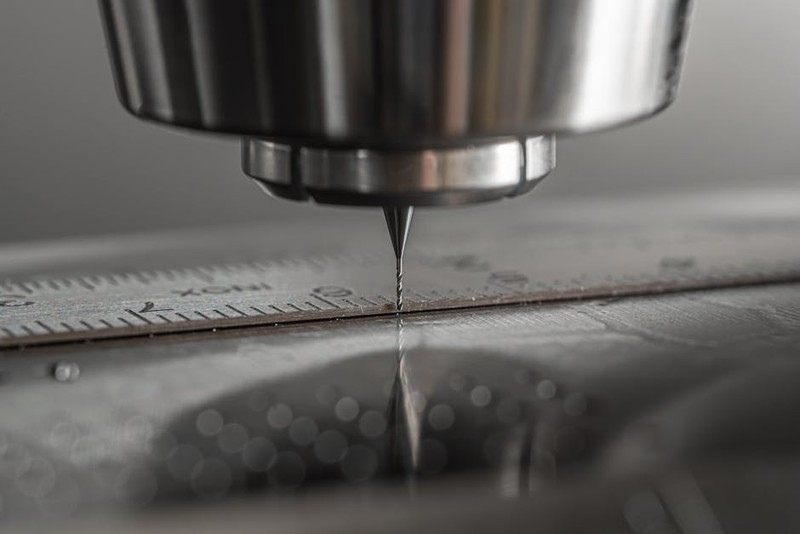
⚙️ Phase 2: The Finishing Ballet
This is where the artisan’s touch is programmed into the machine. Speed and feed are dialed to a harmony that produces a “phonographic” finish—long, consistent, directional tool marks that are predictable and easy to polish out.
Climb vs. Conventional: We almost exclusively use climb milling for finishing. This ensures the cutting edge engages the material at its thinnest point, shearing it cleanly rather than rubbing and work-hardening it.
Toolpath Overlap: We program a minimum of 30% stepover on finishing passes. A smaller stepover might seem precise, but it often leads to tool flutter and inconsistent marks. A controlled, overlapping path is king.
The “One-Pass” Myth: There is no such thing as a single perfect finishing pass. We use a graduated approach: a semi-finish pass to within 0.010″, a primary finish to within 0.002″, and a final “kiss” pass with a freshly measured tool to remove the last tenths.
Case Study: The Chronometer Bridge
A prominent Swiss watch movement manufacturer approached us with a nightmare. Their signature chronograph bridge, a skeletonized component made of German silver (a copper-nickel-zinc alloy notorious for being gummy and soft), had a 15% visual rejection rate after rhodium plating. Under macro photography, tiny pits and inclusions were visible.
💡 Our Investigation & Solution:
1. Root Cause Analysis: We discovered the issue wasn’t contamination, but micro-tearing. The standard carbide end mills were “smearing” the material rather than cutting it, trapping microscopic voids that plating later accentuated.
2. Material-Specific Tooling: We sourced single-crystal diamond-coated end mills. Diamond provides the ultimate sharpness and lubricity for non-ferrous metals, producing a truly sheared cut.
3. Process Adjustment: We implemented high-speed machining (HSM) strategies with very high spindle speeds and low radial engagement, effectively “slicing” the material rather than pushing it.
4. In-Process Validation: We instituted a 10x magnification inspection of the first-off part from every batch, comparing it to a gold-standard sample under identical lighting.
The Result: The visual defect rate plummeted from 15% to 0.07%. The client’s plating yield increased dramatically, and the component exhibited a sharper, more brilliant “Anglage” (bevel) after hand-finishing. The project solidified a fundamental truth: Sometimes, the solution isn’t a faster machine, but a sharper, more thoughtful tool.
Actionable Insights for Your Next Project
If you are sourcing CNC milling services for a luxury component, move beyond the RFQ that only lists tolerances. Engage your machinist as a partner in material science. Here is your checklist:
Ask About Their “First-Cut” Philosophy: How do they approach roughing? If the answer is only about metal removal rate, be wary.
⚙️ Request a Material-Specific Process Sheet: A true expert will have documented parameters and tooling strategies for luxury alloys like 904L steel, zirconium, or proprietary bronzes.
💡 Define “Finish” Qualitatively: Provide not just a Ra number, but a sample or a description: “like a brushed liquid” or “a black mirror.” Send a sample part you admire.
Audit Their Metrology: Do they have white-light interferometers or advanced surface profilometers to measure finish, or do they just rely on a visual check?
⚙️ Plan for Post-Processing: The best milling sets up the subsequent steps—polishing, plating, PVD coating—for success. Design your process backward from the final finish.
The journey from a digital model to an object of desire is paved with a thousand deliberate decisions. In the world of luxury, where the margin for error is zero and the expectation is sublime, CNC milling is not a manufacturing step; it is the foundational act of creation. It is the unseen art that makes the seen object extraordinary.