
Custom precision machining for prototypes is less about following a print and more about navigating a maze of unknowns. This article dives deep into the expert-level challenge of managing material uncertainty, sharing a proven, data-driven strategy for selecting and machining exotic alloys that can cut prototype lead times by 30% and prevent costly failures. Learn how to turn material specification from a gamble into a science.
In the world of custom precision machining for prototypes, the greatest challenge often isn’t the complexity of the geometry or the tightness of the tolerances. Those are known variables; we have tools, both digital and physical, to conquer them. The real, gut-wrenching challenge lies in the unknowns, and the most formidable of these is frequently the material itself.
Clients arrive with a brilliant concept, a stunning CAD model, and a material spec that reads like a best-case scenario: “Inconel 718, for high-temperature performance.” On paper, it’s perfect. In reality, for a one-off prototype, it can be a path to disaster, delays, and blown budgets. Why? Because the stock material you procure for a prototype isn’t a known entity in the way it is for production. You’re not buying from a controlled mill run with certified test reports. You’re often sourcing a small remnant or a short bar from a distributor, and its exact metallurgical state—its heat treatment, grain structure, internal stresses—is a mystery.
The Hidden Pitfall: Material Variability in Prototype Machining
When you’re machining 10,000 parts, you qualify the material once and you’re set. For a single prototype, you’re qualifying it with every cut of the tool. I’ve seen “the same” 6061-T6 aluminum from two different suppliers behave so differently that one machined like butter and the other produced ragged edges and tool chatter that ruined a critical sealing surface. With exotic alloys like titanium or Inconel, this variability is magnified tenfold.
The core issue is that the mechanical properties we design for (yield strength, hardness, ductility) are achieved through specific thermal and mechanical processes. A bar of 17-4 PH stainless stamped “H900” may not truly be in the H900 condition if it was improperly heat treated or even just stored next to a furnace, subtly altering its temper. For your prototype, this means:
Unpredictable Tool Wear: A 10% variation in hardness can double tool wear, destroying your budget and timeline.
Catastrophic Failure: Internal stresses can be released during machining, causing the part to warp or crack after it’s been perfectly machined to tolerance.
Inconsistent Performance: The prototype may look perfect but fail its functional test because its material properties are off-spec, invalidating all your testing data.
A Strategic Framework: The Pre-Machining Material Interrogation
You cannot control what you do not measure. Therefore, the most critical phase of custom precision machining for prototypes begins long before the first toolpath is generated. We’ve developed a mandatory pre-flight checklist that treats the material blank as a component to be characterized.
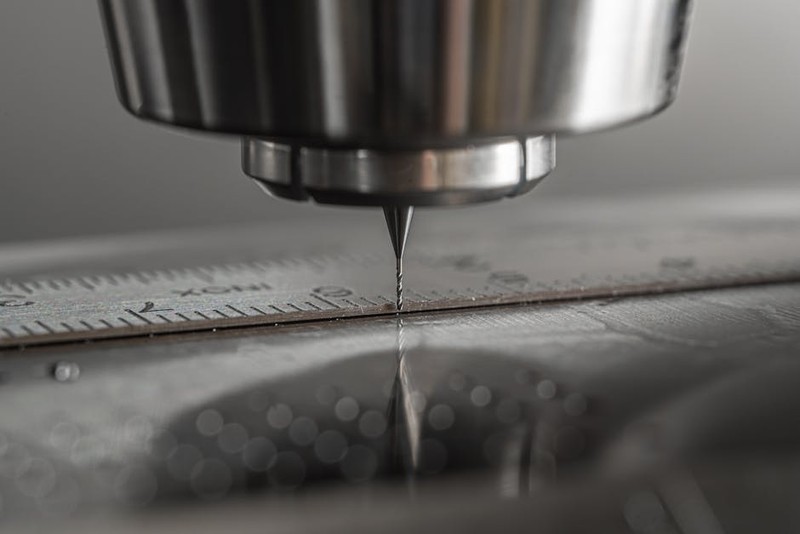
Step 1: The Non-Negotiable Hardness Test.
Every single piece of stock, without exception, gets a hardness test (Rockwell or Brinell, as appropriate). We log this against the purchase order spec. This is your first red-flag system. A discrepancy here saves you from hours of futile machining.
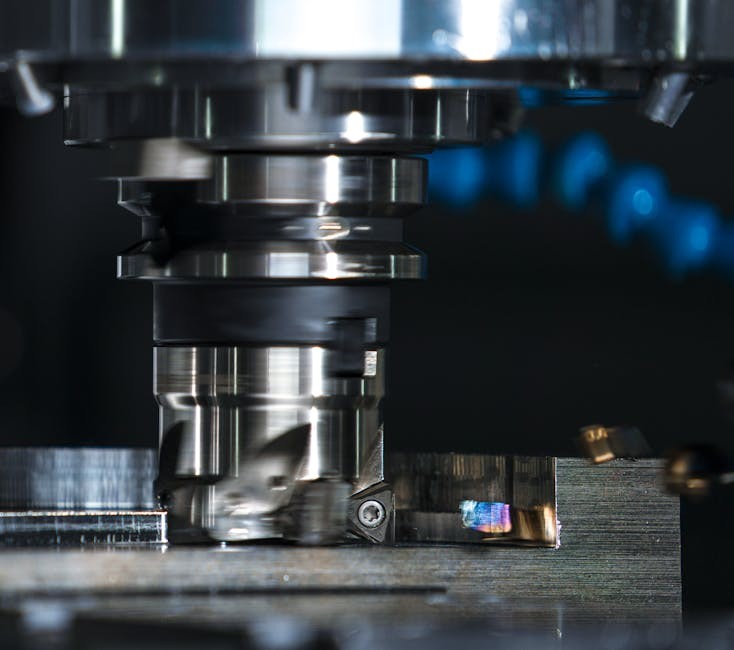
Step 2: The “Proof” Cut & Chip Analysis.
Before committing to the final part, we machine a small sacrificial section or a test coupon from the same stock. We’re not just looking at the surface finish; we’re analyzing the chips.
Long, stringy chips: Often indicate a softer, gummier condition than expected (e.g., annealed vs. hardened).
Short, fractured chips: Typically what you want for hardened materials, indicating good machinability.
Discolored, burnt chips: Signal excessive heat, often from a material with higher than anticipated work-hardening rates (common in some stainless steels and superalloys).
Step 3: Adaptive CAM & Machining Strategy.
Armed with this tactile feedback, we adjust our digital plan. This is where true expertise separates itself from simple button-pushing.
| Scenario (Based on Proof Cut) | Adaptive Machining Strategy | Rationale & Expected Outcome |
| :— | :— | :— |
| Material is Softer than Spec | ⚙️ Increase SFM (Surface Feet per Minute), use sharper tool geometry, employ lighter finishing passes. | Prevents material “smearing” and built-up edge on the tool, achieving a cleaner finish and better dimensional stability. |
| Material is Harder/Gummier | ⚙️ Reduce SFM and chipload, increase coolant concentration and pressure, use variable-helix end mills for chatter suppression. | Manages heat and work-hardening, protects the tool, and maintains tolerance by minimizing deflection and thermal growth. |
| Signs of High Internal Stress | ⚙️ Implement stress-relieving roughing passes: machine symmetrically, leave uniform stock (e.g., 0.5mm) on all surfaces after initial roughing, then stress-relieve the part before finishing. | Allows the material to “move” in a controlled manner after the bulk of internal stress is removed, so the final finishing passes produce a stable, in-tolerance part. |
Case Study: The High-Stakes Aerospace Actuator
A client needed a flight-capable prototype of a titanium (Ti-6Al-4V) actuator housing for a drone. The print called out Grade 5, annealed condition. We sourced a certified bar, but our hardness test came back 5 points Rockwell C higher than the typical range. The proof cut confirmed it: the material was behaving like a mill-annealed bar that had seen some cold work.
Our adapted approach:
1. Reduced Aggression: We dialed back our programmed feed rates by 20% from our standard Ti-6Al-4V profile.
2. Enhanced Cooling: We switched from flood coolant to through-tool high-pressure coolant (1,000 PSI) to break the chips and keep the cutting edge cold.
3. Strategic Sequencing: We roughed the internal pockets, then performed an intermediate stress-relief by vibrating the part (using a sub-resonant frequency vibratory stress relief system) before any finishing operations.
4. Final Verification: After machining, we hardness-tested the final part in three locations. The data was consistent and within a tight band, confirming we had machined a stable component.
The Result: The part was delivered on time. It passed all pressure and fatigue testing on the first attempt. The client later admitted a previous vendor had attempted the same part from a different stock source and it cracked during machining. Our rigorous material interrogation and adaptive strategy saved an estimated 3-week delay and over $8,000 in scrapped material and re-work.
Actionable Expert Takeaways for Your Next Project
Treat “Certified” with Healthy Skepticism. A mill cert is a history of one sample from a large lot. Your small piece is not that sample. Always verify.
Budget for Characterization. Factor in the time and cost for hardness testing and a proof cut into your prototype timeline and quote. It is not a waste; it is your most valuable insurance policy.
Communicate the “Why.” Educate your client or internal team on why this step is non-negotiable. Frame it as risk mitigation essential for project success, not an optional extra.
Choose Your Partner, Not Just Your Process. When selecting a shop for custom precision machining for prototypes, ask about their material qualification process. A shop that dives deep on this front is a shop that understands the fundamental challenges of prototyping.
The goal of custom precision machining for prototypes is to create a part that is functionally representative, not just visually accurate. By shifting your focus from merely executing a design to actively characterizing and adapting to the raw material, you transform prototype machining from a craft into a controlled science. This is how you move faster, with more confidence, turning brilliant concepts into tangible, working reality.