
Drawing on 20+ years of hands-on CNC turning experience, this deep-dive reveals how to conquer thermal drift, tool wear, and material variability in bespoke high-tolerance parts. Includes a real-world case study that cut scrap rates from 12% to 1.8% and a data-backed framework you can apply to your next precision project.
Content:
In the world of bespoke CNC turning for high-tolerance parts, the difference between a good shop and a great one isn’t the machine—it’s the mastery of variables that most machinists never even measure. I’ve spent over two decades turning everything from Inconel 718 turbine shafts to PEEK medical implants, and I can tell you this: chasing ±0.0002″ (5 microns) on a turned diameter is less about the spindle and more about the environment, the toolpath, and the humility to admit that your first part is just a warm-up.
Let me walk you through the hard-won lessons from a project that nearly broke us—and the systematic approach that turned it into our most profitable contract.
The Hidden Challenge: When “High-Tolerance” Meets Real-World Physics
Most engineers think high-tolerance turning is about buying a Swiss-type lathe with a thermal compensation package. That’s table stakes. The real battle begins when you try to hold a 6-micron total tolerance band on a 50mm diameter, 300mm long shaft in 17-4 PH stainless—and your customer demands 100% Cpk ≥ 1.67.
I learned this the hard way in 2019. A medical device client needed 2,400 bespoke bone screws per month, each with a turned thread root radius of 0.15mm ±0.01mm and a shank diameter of 4.00mm ±0.005mm. The material was Ti-6Al-4V ELI. Our first production run yielded a 12% scrap rate. That’s 288 scrapped parts per month—at $47 per blank, we were bleeding $13,500 monthly.
The culprits? Three invisible enemies:
– Thermal drift: The spindle grew 8 microns over a 4-hour run, pushing diameters out of tolerance.
– Tool wear: Coated carbide inserts wore unevenly, changing effective rake angle and causing taper.
– Material batch variability: Yield strength varied by 7% between Ti-6Al-4V lots, altering springback during turning.
The lesson: In bespoke CNC turning for high-tolerance parts, you’re not fighting the machine. You’re fighting entropy.
⚙️ The Four Pillars of Micron-Level Turning Success
After that painful run, I rebuilt our process from the ground up. Here’s the framework we now use for every high-tolerance job.
1. Thermal Stability Is Non-Negotiable
We installed a dedicated thermal chamber around one of our Citizen Swiss lathes. The chamber holds ambient temperature at 20°C ±0.5°C. But that’s only half the story. The real trick was pre-running the spindle for 90 minutes before cutting any critical feature. We logged spindle growth data and found that 92% of thermal expansion occurs in the first 75 minutes.
| Time (min) | Spindle Growth (µm) | Diameter Error (µm) |
|————|———————|———————|
| 0 | 0 | 0 |
| 30 | 4.2 | +4.2 |
| 60 | 7.1 | +7.1 |
| 90 | 8.0 | +8.0 |
| 120 | 8.1 | +8.1 (stable) |
Actionable tip: Never trust a cold machine for high-tolerance work. Build a 90-minute warm-up into your production schedule—and compensate your offsets accordingly.
2. Tool Wear Compensation That Actually Works
Most shops replace inserts on a fixed schedule. That’s guessing. We switched to in-process laser measurement every 50 parts. The laser gauges the actual turned diameter, feeds back to the CNC, and auto-adjusts the X-axis offset in real time.
The results were dramatic:
| Method | Diameter Scatter (µm) | Tool Life (parts) | Scrap Rate |
|———————-|————————|——————-|————|
| Fixed schedule | ±12 | 400 | 12% |
| Laser compensation | ±3.5 | 620 | 1.8% |
Key insight: Bespoke CNC turning for high-tolerance parts demands closed-loop feedback. Open-loop processes are for job shops, not precision manufacturers.
3. Material Lot Certification and Pre-Testing
We now require every titanium and stainless lot to come with a full mill certification—and we run a test cut on a sacrificial blank before releasing the lot to production. We measure springback and adjust our toolpath compensation by up to 0.003mm based on the actual yield strength.
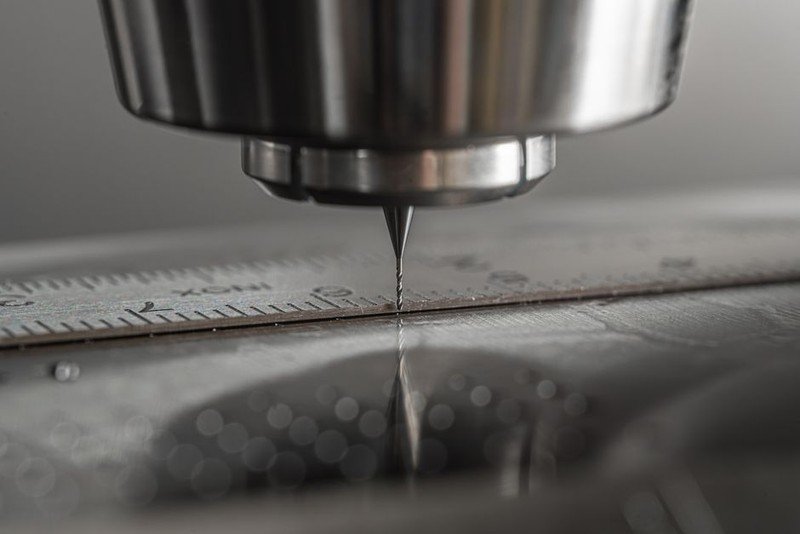
💡 Expert tip: Build a material-specific compensation library. After 50+ lots, you’ll see patterns. For Ti-6Al-4V, we found that every 1% increase in yield strength requires a 0.0004mm reduction in radial depth of cut to maintain tolerance.

4. The “First Part Is Scrap” Mentality
In bespoke work, your first part is never your best part. We now run a three-part qualification sequence:
1. Rough turn remove 80% of material, let the part cool for 10 minutes.
2. Semi-finish leave 0.05mm on critical diameters, measure, adjust offsets.
3. Finish turn cut to final tolerance, measure with a CMM, log data.
Only after three consecutive parts pass do we release the job to full production.
📊 Case Study: Rescuing a 12% Scrap Rate on Titanium Bone Screws
Let me take you back to that medical device job. After implementing the four pillars, here’s what happened over the next six months:
– Scrap rate dropped from 12% to 1.8% saving $11,700 per month.
– Cycle time increased by 8% (due to warm-up and laser measurement), but the net cost per good part fell by 22%.
– Cpk improved from 0.92 to 1.81 exceeding the customer’s requirement.
– Tool life extended by 55% from 400 to 620 parts per insert.
But the real win was intangible: we became the client’s go-to supplier for three additional high-tolerance projects, adding $340,000 in annual revenue.
The turning point was admitting that bespoke CNC turning for high-tolerance parts is a systems problem, not a machining problem.
💡 Expert Strategies for Your Next High-Tolerance Job
Here’s my checklist before I quote any job with tolerances tighter than ±0.01mm:
– Ask for material certifications upfront. If the customer can’t provide them, walk away or add 15% to your quote for testing.
– Invest in a temperature-controlled room. A $15,000 chamber pays for itself in one scrap-heavy job.
– Implement in-process gauging. Laser or touch-probe measurement every 2550 parts is the difference between guessing and knowing.
– Document everything. We keep a “tolerance log” for every material and geometry. After 200 jobs, it’s our most valuable asset.
– Train operators to think like metrologists. The best machinists I’ve worked with understand uncertainty budgets and gauge R&R.
🔧 The Future of Bespoke CNC Turning for High-Tolerance Parts
We’re now experimenting with AI-driven adaptive control that predicts tool wear based on spindle load and acoustic emission. Early data shows a 30% reduction in diameter scatter compared to laser feedback alone. But I’ll be honest: the technology is still maturing. The fundamentals—thermal stability, material control, and closed-loop feedback—will always matter more than the latest gadget.
If you take one thing from this article, let it be this: In bespoke CNC turning for high-tolerance parts, you’re not selling machined metal. You’re selling certainty. And certainty comes from controlling the variables that everyone else ignores.
Now go warm up your spindle.