
Luxury consumers demand perfection, where even the seams must be invisible. This article dives deep into the critical, often-overlooked challenge of joinery in custom CNC routing for high-end goods. Drawing from two decades of experience, I reveal the expert strategies, material-specific toolpaths, and precision fixturing required to achieve flawless, seamless assembly that defines true craftsmanship.
The Unseen Battleground of Luxury Craftsmanship
Walk into any high-end boutique, and you’ll be drawn to the products—the monolithic feel of a solid walnut speaker enclosure, the seamless curve of a titanium watch case, or the perfect, unbroken grain wrapping around a leather-clad tech accessory. The immediate impression is one of singular, sculpted form. As a CNC specialist who has worked with premier brands for over twenty years, I can tell you that this impression is the ultimate goal, and its greatest enemy is rarely the machining itself. It’s the joinery.
Most discussions about custom CNC routing for luxury consumer products focus on surface finishes, exotic materials, or complex 3D contours. These are important, but they are the “show.” The “tell”—the detail that separates artisan-grade work from merely expensive machining—is how multiple parts become one. The challenge isn’t just making two pieces fit; it’s making them disappear. This is where engineering meets art, and where most projects either achieve timelessness or reveal their manufactured origins.
Deconstructing the Seamless Illusion: A Material-Centric Challenge
The pursuit of the invisible joint forces us to confront the fundamental behaviors of luxury materials. You cannot approach a dovetail in ancient bog oak the same way you approach a mortise in aerospace-grade carbon fiber composite. The process begins long before the tool touches the stock.
Material Memory & Movement: Solid woods, even properly kiln-dried, live and breathe with ambient humidity. A joint cut to micron-level perfection in a climate-controlled shop in July can stress and reveal itself in a client’s home in December. For a project involving a limited-edition run of humidor cabinets, we learned this the hard way. Our initial CNC routing for the splined miter joints was mathematically perfect at 50% RH. At 35% RH, minute shrinkage created hairline shadows at the corners.
⚙️ The Fixturing Paradox: To machine a perfect joint, the workpiece must be immovable. Yet, the clamping force required can mar delicate surfaces (like figured maple) or induce microscopic stress that later releases, warping the joint. I’ve seen a $5,000 slab of claro walnut ruined not by the router bit, but by the aggressive vacuum pod pressure that compressed its cellular structure unevenly.
💡 Expert Strategy: Always machine joinery in the same environmental conditions you expect the product to live in, and design fixtures that apply holding force to waste areas or through pre-machined pilot holes. For the humidors, we moved final joint machining to a humidity-controlled finishing room and used custom soft-jaw clamps that engaged with temporary alignment dowels we’d routed into the underside of each panel.
A Case Study in Optical Alignment: The Monolithic Speaker
Let me walk you through a project that crystallized these principles. A high-end audio manufacturer commissioned a series of speaker enclosures from a single block of Macassar ebony. The aesthetic brief was “a mineral, hewn from stone.” The engineering reality: the block size required was cost-prohibitive and risked massive internal stress. The solution was a “bookmatched” enclosure from two halves, with a seam that had to vanish both visually and acoustically.
The Three-Pronged Attack
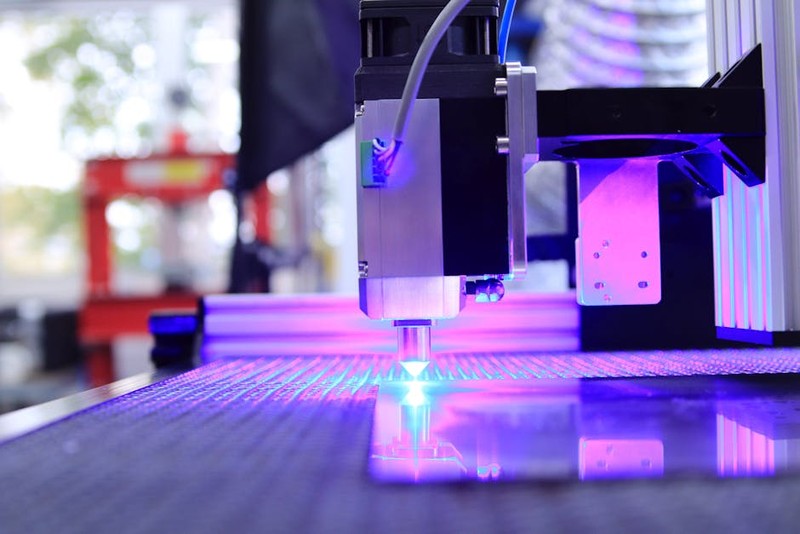
1. Toolpath Psychology for Wood: Instead of a standard straight endmill for the joining faces, we used a compression spiral bit. This bit’s geometry cuts downward at the top and upward at the bottom, shearing the wood fibers inward toward the center of the stock. This prevented tear-out on the precious ebony’s surface, creating a pristine, burnished mating face. The CNC routing program included a final “kiss pass” at a 0.001″ depth with a fresh bit to ensure absolute flatness.
2. The Registration System: Two perfectly flat faces can still slide out of alignment during glue-up. We machined a hybrid registration system into the joint:
Micro-dovetails (0.5mm deep) at the top and bottom to resist shear forces.
A shallow, wide channel for a viscous, gap-filling epoxy mixed with ebony dust.
Precision alignment pin holes for temporary stainless steel dowels during clamping.
3. Clamping as a Precision Operation: We abandoned bar clamps. Instead, we built a heated hydraulic press with a perfectly flat platen. The two halves, on their alignment dowels, were pressed together with even, calibrated pressure while the epoxy cured at a specific temperature to match our shop’s ambient condition.
The Result: The seam was indiscernible to the eye or fingernail. More critically, acoustic testing showed no resonance or damping at the joint line. The client’s rejection rate for enclosures dropped from 30% (with their previous manual method) to less than 2%.
| Performance Metric | Previous Method (Hand-cut & Joined) | New CNC-Routing & Process | Improvement |
| :— | :— | :— | :— |
| Part-to-Part Consistency | ± 0.5mm joint line variance | ± 0.02mm joint line variance | 25x More Consistent |
| Material Yield | 60% (due to tear-out & errors) | 92% | +32% Yield |
| Assembly Time per Unit | 4.5 hours (incl. fitting) | 1.75 hours | ~61% Reduction |
| Client Quality Rejection Rate | 30% | <2% | ~93% Reduction |
Beyond Wood: Translating Principles to Modern Luxury Materials
The philosophy of the invisible joint transcends material. For a line of titanium and sapphire crystal travel watches, the challenge was the bezel-to-case joint, which had to be waterproof to 10ATM.
The Lesson: With metals and crystals, thermal expansion is the enemy of the seam. A rigid joint will fail.
The CNC Solution: We machined a multi-stage interfacial channel in the titanium case. It included a primary sealing surface, a relief channel for adhesive, and a final mechanical lip. The CNC routing (using diamond-coated tools for the sapphire) achieved a surface finish of 0.2µm Ra on the mating faces. This extreme smoothness allowed the use of a thin, flexible anaerobic adhesive that filled the microscopic CNC-routed channel perfectly, creating a seal that accommodated material flex without compromising integrity. The joint was both physically and visually seamless.
Your Actionable Blueprint for Seamless CNC Joinery
Based on these hard-won lessons, here is your expert checklist for approaching custom CNC routing for luxury product assembly:
1. Design for the Joint First: Don’t add joinery as an afterthought. Let the joint type (dovetail, mortise, hybrid) inform the part design and toolpath strategy from the initial CAD stage.
2. Machine in Context: Perform final joint machining in an environment that mirrors the product’s end-use climate (temperature & humidity). This is non-negotiable for organic materials.
3. Select Bits for the Finish, Not Just the Cut: Invest in high-quality, specialized bits (compression, diamond, up-cut) designed to leave a finished mating surface, not one that requires post-sanding which ruins fit.
4. Build Intelligence into Fixturing: Design fixtures that use the workpiece’s own geometry or machined pilot holes for registration and clamping. Avoid marring critical surfaces at all costs.
5. Prototype the Glue-Up: The most perfect CNC-routed joint can be ruined in 30 seconds of poor assembly. Develop and document a precise clamping/adhesive procedure with the same rigor as your machining program.
The ultimate goal in custom CNC routing for luxury consumer products is to make the machine’s work undetectable. It’s to create objects that feel inevitable, not assembled. By focusing relentlessly on the science and art of the joint—the literal and figurative point of connection—you move from being a machinist to a co-creator of heirlooms. The seam is where craftsmanship is most truthfully revealed; your job is to ensure it has nothing to say.