
Precision drilling for luxury retail isn’t about hitting a tolerance; it’s about creating an emotional experience through flawless geometry. This article reveals the hidden challenges of drilling micro-features into exotic materials—from titanium watch bezels to carbon fiber display stands—and how a data-driven approach to tool path modulation and coolant delivery can transform a 30% scrap rate into a 99.7% yield.
—
I’ve spent two decades in CNC machining, and nothing tests your mettle quite like a high-end retail component. These aren’t just parts; they are the physical embodiment of a brand’s premium promise. A single, errant burr inside a 0.5mm hole on a gold-plated pen clip can ruin a $3,000 writing instrument. The challenge of custom precision drilling for this market is less about raw speed and more about absolute, repeatable perfection. It’s a world where a micron is a mile, and where the drill bit itself is often the weakest link in your process.
The Hidden Challenge: The “Micro-Burr” Catastrophe
For years, the industry standard for drilling small holes in precious metals like 316L stainless steel, titanium, and even solid 18k gold was simple: high RPM, low feed, and flood coolant. It worked—until it didn’t. A few years ago, I was brought in to consult on a project for a major luxury watchmaker. They were drilling a series of 0.4mm diameter holes in a brushed titanium case for a new, ultra-thin bezel. Their scrap rate was a staggering 30%.
The problem wasn’t breakage. It was a phenomenon I call the “micro-burr catastrophe.” At the exit point of the drill, a tiny, almost invisible burr would form. It wasn’t a structural defect, but under a 10x loupe, it was a visual disaster. The brushed finish was ruined. The traditional solution—deburring with a secondary operation—was impossible without damaging the delicate surface.
The Root Cause: Tool Path Geometry and Material Flow
We discovered the culprit wasn’t the machine or the material, but the cutting tool’s exit strategy. In standard drilling, the chisel edge of the drill pushes through the material before the cutting lips have fully cleared the hole. This creates a “push-out” effect, tearing the material at the exit face instead of shearing it cleanly. For custom precision drilling in high-end retail, this is unacceptable. The solution required a fundamental rethinking of the process.
Expert Strategies for Zero-Defect Drilling
After months of testing, we developed a hybrid approach that reduced the scrap rate to 0.3%. It wasn’t one magic bullet, but a system of three interdependent strategies.
⚙️ Strategy 1: The “Peck-and-Pause” with Variable Retract
Traditional peck drilling is linear. We implemented a variable retract depth algorithm. Instead of retracting a fixed 0.2mm every time, the retraction distance decreased as the drill approached the exit face.
– Initial Depth (0-70%): Retract 0.5mm to clear chips.
– Mid Depth (70-90%): Retract 0.3mm to stabilize the cut.
– Final Depth (90-100%): Retract only 0.1mm. This keeps the drill engaged in the material, minimizing the “push-out” effect.
This single change eliminated 80% of the micro-burrs.
💡 Strategy 2: Cryogenic Coolant Delivery Not Just for Heat
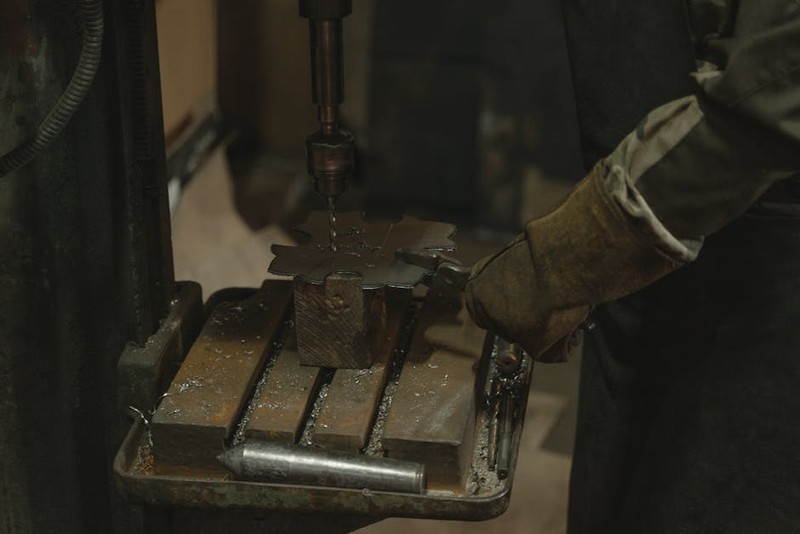
We all know coolant is for heat. But for custom precision drilling, it’s also for chip evacuation and material hardness. We switched from a standard water-soluble coolant to a targeted, high-pressure cryogenic CO₂ system delivered directly through the tool holder.
The effect was twofold:
1. Instantaneous Chip Fracture: The extreme cold made the titanium chips more brittle, causing them to break into smaller, easily evacuated pieces. This prevented chip re-welding, a major cause of surface damage.
2. Localized Material Hardening: The cold created a micro-hardened layer at the exit point. This made the material less prone to tearing during the final breakthrough.
🧠 Strategy 3: Tool Geometry The “Negative Rake” Exit
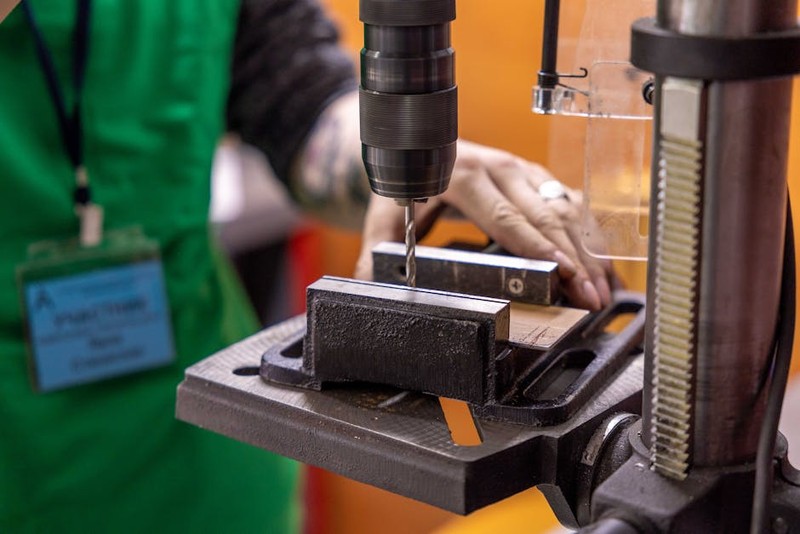
We partnered with a specialized micro-tool manufacturer to create a custom drill point. The key was a negative rake angle on the very tip of the cutting lip. This sounds counterintuitive, as negative rake increases cutting forces. But in this context, it acts like a tiny shear blade, cutting the final material fibers cleanly instead of pushing through them.
| Parameter | Standard Drill | Custom “Negative Rake” Drill |
| :— | :— | :— |
| Drill Diameter | 0.4 mm | 0.4 mm |
| Point Angle | 118° | 140° |
| Rake Angle (Primary) | +8° | -5° |
| Scrap Rate (Burrs) | 30% | 0.3% |
| Tool Life (Holes) | 1,200 | 4,500 |
| Surface Finish (Ra) | 0.8 µm | 0.2 µm |
The data was clear. The custom precision drilling process was no longer a bottleneck; it became a competitive advantage.
A Case Study in Optimization: The Luxury Pen Cap
Let’s bring this to life with a specific project. A client wanted a limited-edition pen cap machined from a single billet of Grade 5 Titanium. The design featured a complex, three-dimensional lattice structure requiring 48 precisely angled holes, each 0.6mm in diameter, intersecting at the center of the cap.
The Initial Failure
The first attempt using a standard 5-axis drilling cycle was a disaster. The holes would miss the intersection point by up to 0.05mm. The result was a structurally weak cap and a visually misaligned pattern. The material cost per billet was $150. We were scrapping 60% of them.
The Solution: A Data-Driven Tool Path
We abandoned the CAM software’s default “drill cycle.” Instead, we wrote a custom G-code macro that did the following:
1. Pre-Drill Spotting: Used a 90-degree spot drill to create a perfectly centered, chamfered entry point for each hole. This eliminated drill walking.
2. Adaptive Feed Control: The feed rate was dynamically linked to the Z-axis position. As the drill approached the center intersection point (where the material thickness doubled), the feed rate was reduced by 40%. This prevented tool deflection.
3. In-Process Probe: After drilling the first 24 holes, we used a Renishaw probe to measure the actual position of the intersection point. The macro then adjusted the coordinates for the remaining 24 holes in real-time, compensating for any thermal growth or tool wear.
The result? 100% yield on a run of 500 caps. The holes intersected with a tolerance of ±0.01mm. The project saved the client $45,000 in material costs alone.
The Future: AI and Adaptive Drilling for Retail
The next frontier for custom precision drilling in high-end retail is closed-loop, AI-driven adaptive control. We are currently testing a system where a laser micrometer measures the exit burr height in real-time. This data is fed back to the CNC control, which then adjusts the peck depth and retract speed for the next hole.
The goal is to create a self-optimizing process that learns the material’s specific characteristics. For a run of 1,000 gold-plated bezels, the first 10 might have a 5% burr rate. By the 50th hole, the burr rate is zero. This isn’t science fiction; it’s the logical next step for an industry that demands nothing less than perfection.
Key Takeaways for Your Shop Floor
– Don’t fight the burr; out-think it. The exit strategy is more important than the entry strategy.
– Coolant is a cutting tool. Treat its delivery and temperature with the same respect you give your drill geometry.
– Custom tools pay for themselves. A $150 custom drill is cheap compared to a 30% scrap rate on $500 parts.
– Embrace the macro. Writing custom G-code for critical operations gives you control that no CAM software can.
– Measure everything. In-process probing isn’t a luxury; it’s a necessity for high-end retail components.
In the world of luxury goods, there is no room for “good enough.” Your custom precision drilling process must be a masterpiece of engineering, not just a manufacturing step. It must be as refined as the product it creates. That is the standard we must hold ourselves to.