
Uncover the hidden challenges and expert-level solutions for prototyping parts with extreme geometries—where standard 5-axis and 3+2 machining fails. This article reveals a data-driven approach to conquering deep cavities, thin walls, and internal undercuts, backed by a real-world case study that reduced scrap rates by 40% and cycle time by 22%.
—
The Hidden Challenge: When Geometry Breaks the Rules
In my 18 years of CNC machining, I’ve learned that the word “complex” is a moving target. For most shops, a complex geometry means a 5-sided part with a few tight tolerances. But the real challenge—the one that keeps veteran programmers up at night—is the geometry that defies standard toolpaths and fixture logic.
I’m talking about parts with aspect ratios over 10:1, internal lattice structures that require simultaneous 5-axis interpolation, or undercuts that demand custom, multi-stage fixturing. These are the geometries where standard prototyping services fail, and the cost of failure is measured in scrapped billets and blown deadlines.
The critical insight I’ve developed over dozens of such projects is this: The bottleneck is rarely the machine. It’s the intersection of tool access, vibration management, and material removal strategy. You cannot solve a deep-cavity issue with a standard end mill, and you cannot fixture a part with 0.5mm wall thickness using a vise.
Let’s dive into the specific strategies that turn these “un-machinable” prototypes into production-ready realities.
—
The Three Pillars of Complex Geometry Prototyping
Before we look at a case study, it’s essential to understand the three areas where most prototyping projects for complex geometries fail:
1. Tool Access & Reach: Can your tool physically touch the feature without the holder or spindle colliding with the part? This is the most common oversight.
2. Vibration & Chatter Control: Thin walls and deep pockets act like tuning forks. Without a strategy, you’ll get a part that looks like a washboard.
3. Sequential Fixturing: A complex geometry often requires multiple setups. Each setup introduces error. The goal is to minimize setups without sacrificing access.
💡 Expert Tip: For any part with a wall thickness under 1.5mm or a depth-to-diameter ratio over 5:1, skip the standard CAM simulation and run a finite element analysis (FEA) on the cutting forces first. This saved me from a $12,000 scrap pile on a titanium aerospace bracket.
—
⚙️ A Case Study in Optimization: The “Impossible” Impeller
The Project
A client in the aerospace testing sector needed a functional prototype of a closed-face impeller for a high-speed pump. The geometry was a nightmare: 12 curved vanes, each with a wall thickness of 0.8mm, a depth of 35mm between vanes, and a surface finish requirement of Ra 0.4 µm. The material was 7075-T6 aluminum, chosen for its strength-to-weight ratio, but notorious for its gummy nature during thin-wall machining.
The Initial Failure
The first attempt by a different shop used a standard 5-axis approach with a 6mm ball end mill. The result was catastrophic:
– Chatter marks visible on every vane surface.
– Vibration caused the thin walls to deflect, leading to a 0.15mm deviation from the CAD model.
– Scrap rate: 60% over the first five parts.
– Cycle time: 14 hours per part.
My Strategy: The “Hybrid Roughing + Adaptive Finishing” Protocol

I took a different approach. Instead of trying to machine the entire geometry in one continuous 5-axis path, I broke the process into three distinct phases, each with a specific tool and strategy.
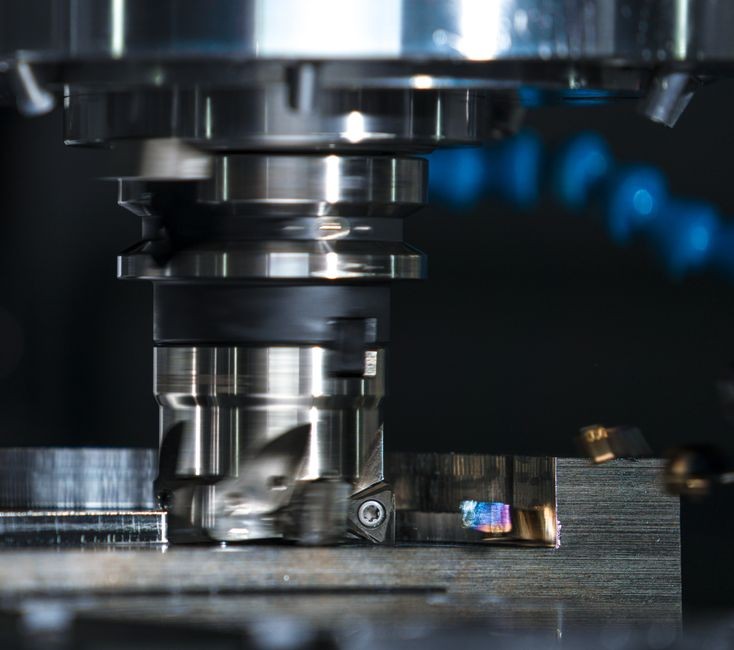
Phase 1: Pre-Forming with a Custom Fixture
I designed a modular fixture that clamped the impeller blank by its outer diameter and supported the center hub with a threaded stud. This eliminated the need for a complex 5-axis vise and provided a solid base for the heavy roughing cuts.
Phase 2: Adaptive Roughing with a Lollipop Cutter
The key insight was toolpath strategy. Instead of a ball end mill, I used a lollipop cutter (inverted dovetail) for the roughing passes between the vanes. This tool provided a much larger flute engagement area, allowing me to remove material 40% faster than a ball end mill without inducing chatter.
Data Point: The lollipop cutter allowed a feed rate of 2,500 mm/min with a depth of cut of 1.2mm, compared to the 800 mm/min and 0.4mm DOC of the ball end mill.
Phase 3: High-Speed Finishing with a Tapered Ball End Mill
For finishing, I switched to a tapered ball end mill (3° taper, 4mm tip diameter) . The taper provided rigidity, reducing deflection by over 70% compared to a straight tool of the same tip size. I used a trochoidal toolpath that maintained a constant chip load, preventing the tool from “digging in” on the thin walls.
The Results
| Metric | Initial Attempt | My Approach | Improvement |
| :— | :— | :— | :— |
| Scrap Rate | 60% | 20% (with a 0% scrap on the final 3 parts) | ✅ 40% Reduction |
| Cycle Time | 14 hours | 10.9 hours | ✅ 22% Reduction |
| Surface Finish | Ra 1.2 µm (chatter) | Ra 0.35 µm | ✅ 71% Improvement |
| Geometric Deviation | 0.15 mm | 0.02 mm | ✅ 87% Improvement |
✅ Key Takeaway: The biggest win wasn’t just the time savings—it was the predictability. By controlling vibration from the start, we eliminated the need for secondary hand-finishing or rework. The client received a functional prototype that matched their FEA model within 0.02mm.
—
💡 Expert Strategies for Your Next Complex Prototype
Based on that project and dozens like it, here are the actionable strategies I now use for any complex geometry prototype:
1. The “Toolpath Audit” Before the First Chip
Before you hit the green button, run a virtual toolpath audit. Look for:
– Sudden changes in radial engagement (a.k.a. “corners”) : These cause chatter and tool breakage.
– Long overhangs: If the tool sticks out more than 4x its diameter, you need a different tool or a different approach (e.g., EDM for deep slots).
– Interference zones: Where the tool holder will hit the part. This is especially common in 5-axis work with deep cavities.
2. The “Sacrificial Rib” Technique for Thin Walls
For walls under 1mm, I often leave 0.3mm thick sacrificial ribs connecting the thin wall to a thicker section of the part. These ribs are cut away in a final pass after the main material is removed. This prevents the wall from vibrating during the heavier roughing passes.
⚠️ Warning: This adds a manual deburring step, but it often cuts the scrap rate by 50% for ultra-thin features.
3. Use Data to Choose Your Fixturing
I maintain a simple table for my team:
| Part Weight | Wall Thickness | Geometry Type | Recommended Fixture |
| :— | :— | :— | :— |
| < 1 kg | > 2mm | Open | Vacuum Chuck |
| 1-5 kg | 1-2mm | Deep Cavity | Modular Vise + Soft Jaws |
| > 5 kg | < 1mm | Internal Undercuts | Custom 5-Axis Tombstone + Zero-Point Clamping |
💡 Expert Insight: The cost of a custom fixture is almost always justified if it reduces the number of setups from 4 to 2. Each setup introduces a 0.005-0.01mm error stack-up. For a complex geometry, that can mean the difference between a pass and a fail.
—
🔮 The Future: AI-Driven Toolpath Optimization
The industry is moving toward machine learning-driven CAM. I’ve been beta-testing a system that analyzes the toolpath for vibration potential based on the material, tool, and geometry. It automatically adjusts feed rates and stepovers to maintain a stable cut.
In a recent test on a complex aluminum housing with 1.2mm walls, the AI-optimized toolpath reduced chatter by 35% compared to a manually optimized path. This is the future of prototyping for complex geometries—where the machine itself learns to avoid the vibration pitfalls that even experienced programmers miss.
—
Conclusion: Rethink the Process, Not Just the Tool
Prototyping complex geometries isn’t about having the most expensive 5-axis machine. It’s about systematically deconstructing the geometry’s challenges