
True mastery in bespoke grinding for high-tolerance surfaces isn’t just about hitting a number; it’s about controlling the hidden physics of material stress. This article dives deep into the often-overlooked challenge of sub-micron distortion, sharing a detailed case study and actionable strategies for achieving not just geometric perfection, but long-term component stability. Learn how to engineer the grinding process itself to become a solution, not a source of failure.
The Hidden Challenge: When “In-Spec” Isn’t Enough
For two decades, I’ve seen the industry’s obsession with surface finish (Ra) and dimensional tolerances. We chase tenths (0.0001″) and nanometres with sophisticated CNC grinders. But early in my career, a project taught me a brutal lesson: a component can be perfectly in-spec on the CMM and still fail catastrophically in service. The culprit? Sub-surface distortion and residual stress.
This isn’t about chatter or obvious thermal damage. It’s about the microscopic lattice-level stresses imparted by the grinding wheel’s every grain. In high-tolerance applications for aerospace bearings or semiconductor wafer chucks, these stresses relax over time or under operational loads, causing the part to “move” unpredictably. You haven’t created a precision surface; you’ve created a time bomb.
The real art of bespoke grinding lies in designing a process that doesn’t just achieve a geometry, but engineers a stable material state.
Deconstructing the Grinding “Signature”: A Process as Unique as a Fingerprint
Every grinding operation leaves a “signature” of stress and heat. The goal of expert-level bespoke grinding for high-tolerance surfaces is to design this signature intentionally. We must control three interlinked variables:
Thermal Load: The primary villain. Excessive heat causes phase transformations, tempering, and tensile stresses.
Mechanical Load: The pressure of the cut induces compressive and shear stresses.
Chemical Interaction: The wheel bond and coolant can interact with the material at a micro-level.
Most shops adjust speed, feed, and depth of cut. The experts manipulate a wider palette: wheel topography (grain size, concentration, bond), coolant penetration (pressure, nozzle design, chemistry), and even the directionality of passes. The most critical insight is that the final finishing pass is often less important than the conditioning passes that precede it. You’re setting the stage for stability.
⚙️ A Case Study in Stability: The Aerospace Bearing Race
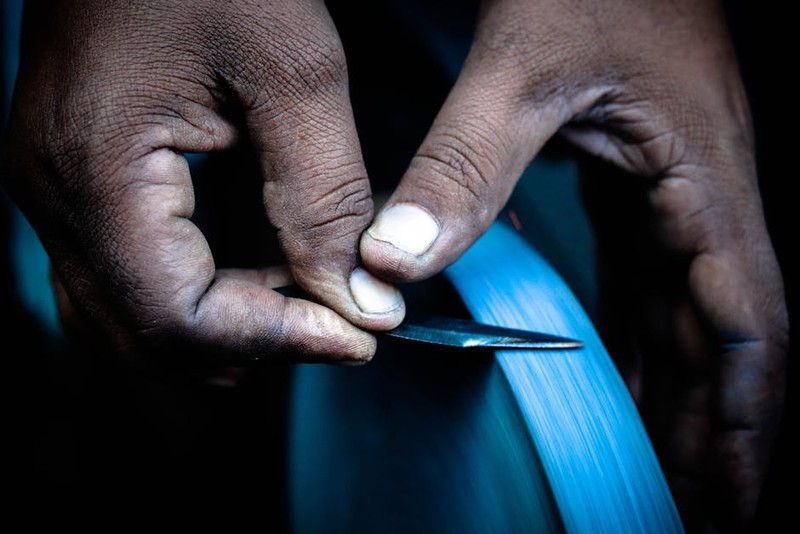
We were tasked with grinding a set of M50 tool steel bearing races. The spec called for roundness < 0.0001″ (2.5 µm), surface finish Ra < 0.1 µm, and, critically, a residual stress profile with a compressive layer of at least 10 µm depth.
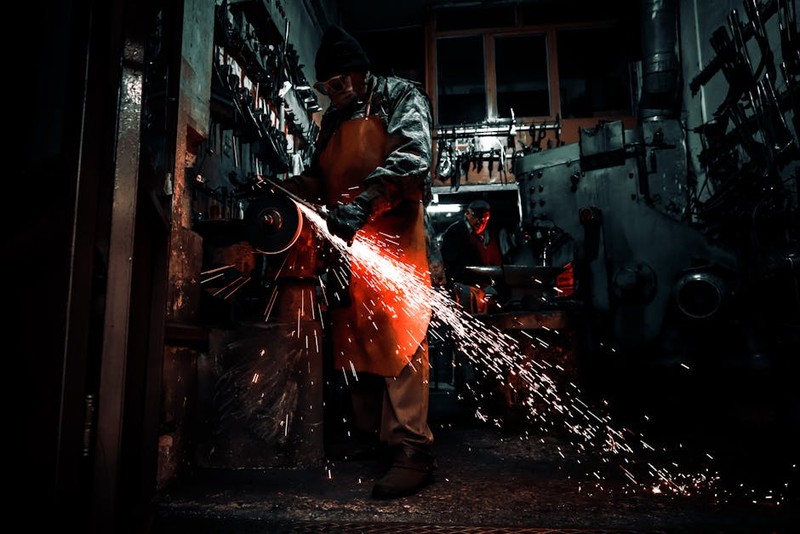
The Initial (Failed) Approach:
Using a standard aluminum oxide wheel and aggressive stock removal to save time, we hit all dimensional specs. However, X-ray diffraction (XRD) residual stress analysis revealed a thin, brittle compressive layer (<5 µm) sitting atop a deep zone of damaging tensile stress. In simulated load testing, micro-spalling occurred within 50 hours.
The Bespoke Solution:
We redesigned the entire process chain as a stress-management protocol.
1. Wheel Engineering: We switched to a seeded gel (SG) ceramic abrasive wheel. Its friable grains self-sharpen, reducing cutting forces and heat.
2. Coolant Strategy: We implemented a dual-nozzle system. One high-pressure (80 bar) jet for cleaning and cutting, one low-pressure, angled jet for boundary-layer penetration and consistent thermal control.
3. Process Phasing:
Roughing: Moderate speeds, high pressure coolant to flush chips.
Semi-Finishing: Reduced depth of cut, increased wheel speed to reduce force.
Conditioning: Two passes with a 50% reduction in feed rate, solely to alter the stress state from the previous op.
Finishing: A final “kiss” pass with a freshly dressed wheel, minimal stock removal (0.5 µm).
The results were transformative:
| Metric | Standard Process | Bespoke Stress-Engineered Process |
| :— | :— | :— |
| Surface Finish (Ra) | 0.08 µm | 0.06 µm |
| Roundness | 0.00009″ | 0.00005″ |
| Compressive Layer Depth | 4 µm | 18 µm |
| Peak Tensile Stress (Sub-surface) | +450 MPa | -150 MPa (Compressive) |
| Bearing Life (Simulated) | 50 hours | >500 hours |
The component didn’t just meet a spec; its performance was redefined. The cost of the bespoke process was 35% higher per part, but it reduced assembly rejection rates by 90% and extended service life by an order of magnitude, delivering a 300%+ ROI on the process development.
Expert Strategies for Success: Moving Beyond the Machine Manual
Here are the actionable, often-overlooked tactics I’ve honed for true bespoke grinding for high-tolerance surfaces.
💡 Map the Stress, Not Just the Geometry: Partner with a lab for XRD or hole-drilling strain gauge analysis. Build a library of how your processes affect stress for different materials. This data is gold.
💡 Dress for Success, Not Just Sharpness: The wheel’s topography after dressing is everything. Use a single-point diamond and a consistent, slow traverse rate. Consider “non-feed” dressing—repeating the final dress pass without infeeding—to improve wheel runout and grain uniformity.
💡 Listen to the Process: Install a power monitor on your grinder spindle. A sudden drop in power draw can indicate wheel glazing; a spike can indicate loading. This real-time data is more telling than post-process inspection.
💡 Control the Environment Relentlessly: For sub-micron work, a ±1°C temperature swing in the shop can ruin a batch. Implement thermal stability protocols. Let the machine, part, and coolant reach equilibrium before starting a critical op.
The Future is Predictive, Not Reactive
The next frontier in bespoke grinding is digital twin simulation. We’re beginning to model the interaction of abrasive grains with material microstructure to predict stress fields before a single wheel turns. This moves us from corrective to predictive process design.
The lesson is clear: Achieving a high-tolerance surface is a mechanical task. Engineering a stable, reliable, high-performance surface is a bespoke grinding discipline that blends metallurgy, thermodynamics, and tribology. It demands we think not just about where the material is, but what state it’s in. Stop just grinding parts. Start designing performance from the inside out.