
Custom drilling for automotive parts is far more than just following a CAD file. This deep-dive reveals the critical, often-overlooked challenges of material behavior, thermal dynamics, and precision at scale. Learn expert strategies and a real-world case study that reduced scrap rates by 22% and cycle time by 18% through a holistic, data-driven approach.
The Illusion of Simplicity: What Blueprints Don’t Show You
For two decades in CNC machining, I’ve seen countless RFQs for “custom drilling services” on automotive components—from turbocharger housings and transmission valve bodies to high-performance suspension knuckles. On paper, it looks straightforward: a set of holes at specified coordinates. But this perception is the first trap. The true complexity lies not in the geometry, but in the interaction between the tool, the material, and the relentless demands of the automotive industry.
The automotive sector is unforgiving. It demands:
Extreme Precision: Tolerances often within ±0.025mm for critical fluid or alignment passages.
Material Challenges: Drilling into hardened steels, ductile irons, or exotic alloys like Inconel for exhaust components.
Volume & Consistency: Producing 10,000 identical parts where the 10,000th must perform exactly like the first.
Cost-Efficiency: Every second saved in cycle time translates directly to the bottom line.
The most common failure point I observe is treating drilling as an isolated operation. It’s not. It’s a system influenced by everything that came before it—the stock condition, the preceding milling operations, the clamping forces, and even the ambient temperature in the shop.
The Hidden Challenge: Thermal Growth and “Hole Wander”
Let’s dissect a specific, nuanced problem that plagues high-volume custom drilling: thermal-induced positional drift, or what my team calls “hole wander.”
In a project for an electric vehicle’s aluminum inverter housing, we were tasked with drilling a complex pattern of 48 coolant passages, each requiring a positional tolerance of ±0.05mm. The part was large, approximately 400mm x 300mm. We programmed the machine perfectly, used a premium carbide drill, and the first few parts off the line were flawless. By the 50th part, however, our CMM data showed a disturbing trend: the hole pattern was slowly “walking” by up to 0.07mm, scraping the entire batch.
The culprit? The machining process itself generates heat. As the aluminum workpiece absorbed heat from previous milling and drilling operations, it expanded minutely but significantly. Our machine’s probe measured from the same datums, but the material itself had grown, causing the spindle to reference a slightly shifted coordinate system. We were drilling a perfect pattern in the wrong place.
⚙️ Expert Strategy: A Holistic Thermal Management Protocol
Solving this required moving beyond the drill press. We implemented a multi-faceted protocol:
1. Pre-Process Stabilization: All raw billets are now brought to a controlled shop temperature for 24 hours before machining.
2. In-Process Cooling: We integrated through-spindle coolant not just for chip evacuation, but as a primary heat sink, maintaining a consistent temperature at the cutting interface.
3. Strategic Sequencing: We redesigned the CNC program to distribute heat-generating operations evenly, interspersing them with light finishing passes to allow for heat dissipation.
4. Compensated Datuming: We programmed the machine to take critical datum measurements from a ceramic gage pin inserted into a thermally stable master bore machined in the first operation, rather than from the part’s outer edges.
The lesson was clear: You must manage the entire thermal envelope of the part, not just the cutting tip.

A Case Study in Optimization: The Turbocharger Bearing Housing
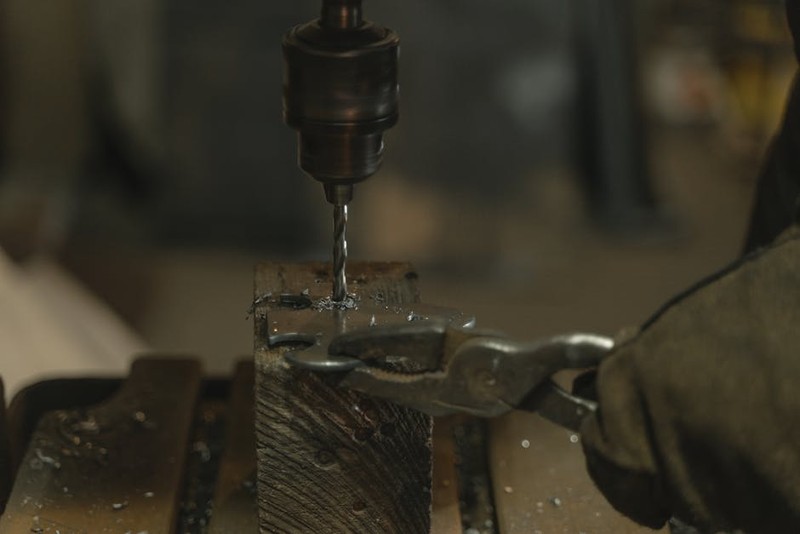
Let me walk you through a concrete example where custom drilling was the linchpin of performance and profitability.
The Challenge: A client needed 5,000 units of a turbocharger center bearing housing made from SAE 4140 steel, heat-treated to 45 HRC. The part required a deep, 8mm diameter oil feed hole with a critical surface finish (Ra < 1.6 µm) and straightness tolerance of 0.01mm over 60mm depth. Their current process had a 15% scrap rate due to drill breakage and poor finish, and a cycle time of 4.5 minutes per part just for this operation.
Our Data-Driven Investigation: We first analyzed the failed drills under magnification. We found inconsistent wear and micro-chipping, indicating unstable cutting conditions. Vibration (chatter) was the invisible enemy.
💡 The Multi-Pronged Solution:
Tooling Innovation: We moved from a standard parabolic flute drill to a solid carbide, internal-coolant drill with a polished flute geometry and a variable helix angle. This design broke chips more efficiently and dampened harmonic vibrations.
Parameter Revolution: Instead of conservative “safe” speeds and feeds, we used a high-pressure coolant system (1,000 psi) to enable high-speed pecking. This technique removes chips instantly, reduces heat, and re-centers the drill.
Machine Integrity: We conducted a full ballbar and laser calibration check on our 5-axis CNC mill to ensure spindle runout was under 0.003mm. A dull tool in a perfect machine is better than a perfect tool in a dull machine.
The Results Quantified:
We tracked the outcome over the first 1,000 parts. The data tells the story:
| Metric | Previous Process | Optimized Process | Improvement |
| :— | :— | :— | :— |
| Cycle Time (per part) | 4.5 minutes | 3.7 minutes | -18% |
| Tool Life (holes/drill) | ~250 holes | ~550 holes | +120% |
| Scrap Rate | 15% | 3% | -22% (absolute) |
| Surface Finish (Ra) | 2.1 – 3.0 µm | 1.2 – 1.5 µm | Exceeded Spec |
The key takeaway: The investment in premium tooling and machine maintenance was dwarfed by the savings in scrap, downtime, and improved throughput. The client’s total cost per part for this operation dropped by nearly 30%.
Actionable Advice for Your Next Project
Based on these experiences, here is my distilled advice when sourcing or planning custom drilling services for automotive components:
Interrogate the Material First. Don’t just know the alloy; understand its condition (annealed, pre-hard, hardened), its thermal conductivity, and its work-hardening tendencies. This dictates everything.
⚙️ Demand a Process, Not Just a Quote. Ask your machining partner how they will control heat, vibration, and chip evacuation. Their answer reveals their depth of expertise.
💡 Embrace Metrology as Part of the Process. In-process probing and post-process CMM verification aren’t just for QC; the data should be fed back to fine-tune the machining program in real-time for a closed-loop system.
Ultimately, successful custom drilling is an exercise in applied physics and relentless precision. It’s about viewing each hole not as a void, but as a precision-engineered interface that must be perfect every single time. By focusing on the hidden systems—thermal, vibrational, and mechanical—you transform a basic machining operation into a reliable cornerstone of automotive performance and manufacturing excellence.