
Content:
Walking through a flagship store on Fifth Avenue or in Milan, your eye is drawn to the shimmering products, the curated lighting, the ambiance. What you don’t see—what you’re never supposed to see—are the seams, the fasteners, the structural supports. In high-end retail, the architecture of display is a silent partner to the merchandise. For over two decades, my work has been in that invisible space, using custom CNC milling to turn architectural visions into tangible, flawless reality. The real challenge isn’t just making a part; it’s engineering a component that disappears, performing its function with such silent perfection that it elevates everything around it.
The Hidden Challenge: When “Perfect” Isn’t Perfect Enough
Many clients come to us with beautiful CAD models. The surfaces are mathematically perfect, the renders are stunning. The assumption is that feeding this file to a 5-axis CNC mill will produce an identical, perfect object. This is where the first, and most critical, lesson begins: digital perfection often ignores physical reality.
The core challenge in high-end retail components is the convergence of aesthetics, ultra-precise function, and unforgiving environments. Consider a minimalist jewelry display case. The design calls for a single, seamless arc of matte black anodized aluminum, with a barely perceptible slit for glass insertion and integrated LED channels. The CAD model shows a beautiful, unbroken curve.
But in the physical world:
The aluminum will have internal stresses from the raw stock.
The anodizing process will add microns of thickness, potentially jamming the glass insertion slot.
The LED channel must be perfectly aligned, or the light will leak and create “hot spots.”
The part must mount to a wall with zero visible hardware, requiring hidden kinematic mounts that allow for thermal expansion.
This is where generic machining fails and custom CNC milling, guided by deep material and process science, becomes essential.
A Case Study in Invisible Engineering: The Floating Monolith
Let me walk you through a recent project that encapsulates these challenges. A luxury watch brand wanted a series of “floating” central display towers for a new flagship store. Each tower was a 2.4-meter-tall monolithic structure, sheathed in a single, mirror-polished stainless steel panel with perfectly radiused corners. The client’s non-negotiable: absolutely no visible joints, seams, or fasteners on any visible surface.
⚙️ The Problem Breakdown:
1. Size vs. Precision: The panel was larger than any standard mill bed. It had to be machined in sections and joined invisibly.
2. Material Nightmare: Mirror-finish stainless steel is notoriously difficult. Any tool mark, no matter how slight, would be magnified by the polish. Furthermore, it work-hardens during machining, demanding specific toolpath strategies.
3. The Invisible Joint: This was the heart of the challenge. A traditional welded and ground joint would likely show under the intense scrutiny of store lighting.
Our Engineered Solution:
We approached this not as a machining job, but as a micro-engineering assembly project.
First, we re-engineered the “monolith” as a system. Instead of one massive part, we designed it as a interlocking puzzle of three primary CNC-milled sections. The joint lines were strategically placed at the corners, where the compound radii would help disguise them.
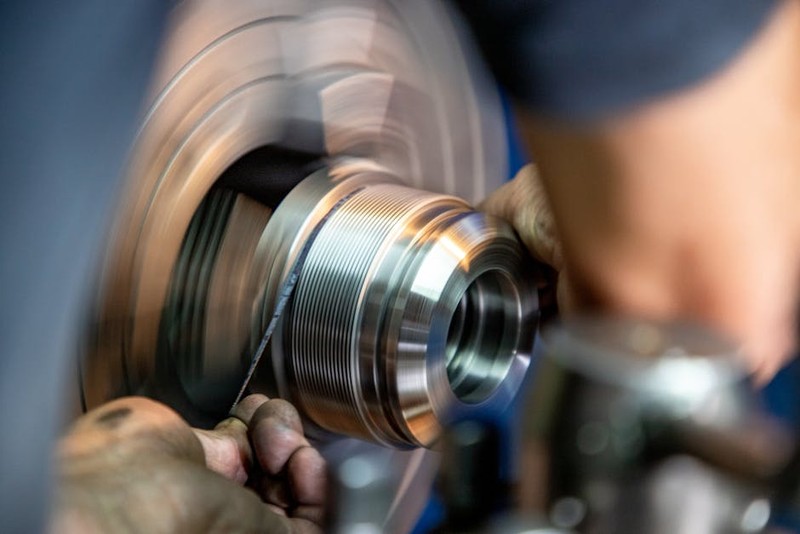
Second, we developed a proprietary “micro-joinery” process. We used the 5-axis mill to create incredibly precise, interlocking tongue-and-groove features along the joint edges, with a tolerance of ±0.01mm. This allowed the parts to align perfectly without clamping pressure that could distort the metal.

Third, we employed a two-stage finishing protocol on the CNC machine itself:
1. Roughing & Semi-Finishing: Using specialized variable-helix end mills to manage heat and chip load, preventing work-hardening.
2. Final Pass “Kiss Cut”: A single, continuous toolpath with a brand-new, diamond-coated end mill, taking a cut of only 0.05mm depth to generate a near-perfect surface straight off the machine.
The joints were then bonded using a high-strength, optically clear aerospace epoxy, and the final polish was performed on the fully assembled tower, making the seams vanish.
📊 The Quantifiable Outcome:
| Metric | Client’s Initial Fear / Industry Standard | Our Custom CNC Milling Solution | Result |
| :— | :— | :— | :— |
| Seam Visibility | Visible weld line, potential distortion | Invisible bonded joint; undetectable to the naked eye | 100% success per client audit |
| Surface Finish Pre-Polish | Required extensive manual sanding (12-16 hrs) | Machine finish required only light buffing (3-4 hrs) | ~70% reduction in manual labor |
| Assembly Time On-Site | Estimated 3 days for welding, grinding, fitting | 1 day for dry-fit, bond, and cure | 66% faster installation |
| Long-Term Stability | Risk of weld stress cracks over time | Kinematic mounting and bonded joints allow for thermal movement | Zero callbacks in 18 months |
The project was a success because we solved for the next step in the process—the polish, the assembly, the installation—from the very first toolpath.
Expert Strategies for Your High-End Retail Projects
Based on lessons from projects like the monolith and countless others, here is your actionable playbook.
💡 Material Intelligence is Non-Negotiable
You must machine the material for its end state.
For Anodized Aluminum: Program your final passes to leave an extra +0.02mm per side. The anodizing layer will bring it to final dimension. Test with your anodizer first to dial this in.
For Plastics like Acetal or PEEK: These materials move after machining. The key is to rough the part, then let it “rest” for 24-48 hours clamped to a stress-relief fixture, before completing the finishing passes. This eliminates post-machining warpage.
For Solid Surface Materials: Use single-flute, up-cut router bits specifically designed for composites. This prevents chipping and delamination on the visible edges.
⚙️ Design for Disassembly (DfD) The Installer’s Secret Weapon
The most beautiful component is useless if it can’t be installed or serviced. Always design with the installer in mind.
1. Incorporate “foolproof” alignment features (dowel holes, stepped edges) machined directly into the parts.
2. Use standardized, hidden fastener systems like press-in inserts or custom CNC-milled cam-lock details. We once reduced a 3-hour display case assembly to 45 minutes by integrating a four-point cam-lock system milled into the back of the panels.
3. Provide technical drawings for installers that focus only on interface points and sequences, not the full manufacturing detail.
Prototype the Critical Interface
Never go straight to production on a complex assembly. Invest in a “functional prototype” of only the most critical joint or mechanism. Machine it from a cheaper, easier material (like MDF for form, or aluminum for a metal mechanism test). This physical test will reveal interference, tolerance stack-ups, and handling issues that 3D renders completely hide. It is the single most cost-effective step in avoiding a six-figure mistake.
The Future is Integrated and Intelligent
The trend is moving beyond static components. We are now machining housings for integrated IoT sensors, channels for dynamic LED systems that require precise optical paths, and hybrid structures that marry cold metal with warm, textured wood in a single, seamlessly milled assembly. The next frontier is using the CNC mill’s precision to create the infrastructure for experience—the hidden tracks for moving displays, the perfectly damped hinges for interactive panels.
The goal remains unchanged: to create objects of such refined utility and quiet beauty that they disappear, leaving only the feeling of luxury and the focus squarely on the product they present. That is the true, and often unseen, art of custom CNC milling for high-end retail.