
High-end retail components demand more than just manufacturing; they require a fusion of engineering precision and artistic intent. This article delves into the critical, often overlooked challenge of achieving flawless surface finishes and perfect assembly tolerances in custom CNC turning for luxury retail, sharing a detailed case study and actionable strategies to transform components from functional parts into objects of desire.
The Silent Challenge: When “Good Enough” Isn’t Good Enough
In the world of high-end retail, every detail is a brand statement. The heft of a door handle, the seamless glide of a drawer, the cold, perfect gleam of a display fixture—these are not accidents. They are the result of meticulous engineering, often hidden in plain sight. For over two decades in precision machining, I’ve seen a common pitfall: brands and even some manufacturers approach these components as simple mechanical parts. The reality is far more complex.
The core challenge in custom CNC turning for high-end retail components isn’t just about holding a tolerance on a drawing. It’s about managing the entire sensory experience—the look, the feel, the sound, and the longevity—through metal. The most significant, underexplored hurdle is achieving a flawless surface finish and perfect assembly fit in high-volume, mixed-material production runs.
Why is this so critical? A microscopically rough surface on a titanium watch winder will feel “gritty” to a customer. A minuscule deviation in the concentricity of a bronze hinge pin will cause a $10,000 display cabinet door to sag imperceptibly over time, breaking the illusion of perfection. In one project I led for a flagship jewelry store, we discovered that a 0.005″ variance in the wall thickness of an aluminum display riser—well within standard commercial tolerances—caused a visible optical distortion under the intense gallery lighting, making the diamonds appear less brilliant.
Deconstructing the Sensory Spec: Beyond the Blueprint
The first step is moving beyond the standard technical data packet. When engaging with a luxury brand, we don’t just ask for drawings; we initiate a “Sensory Specification” session.
Tactile Requirements: Will the component be touched? If so, with what part of the hand (fingertip, palm)? This dictates not just Ra (average roughness) but Rz (mean roughness depth) and even the lay of the finish (circular, linear).
Visual Requirements: Under what lighting? LED, halogen, or natural light? A brushed finish that looks uniform in the workshop can show inconsistent tool paths under directional boutique lighting.
Acoustic Requirements: Does the component move? What sound should it make? The engagement of a magnetic latch turned from stainless steel versus brass produces a fundamentally different “click”—one is sharp and modern, the other is warm and subdued.
Environmental Requirements: Will it be in a humid fragrance hall or handled with acidic skin oils? This influences material choice and post-processing.
This holistic spec becomes our true guide. I recall a project for a high-end audio retailer needing custom brass amplifier knobs. The drawing called for a “mirror polish.” But through discussion, we learned the knobs needed to feel “organic” and “warm,” not slick and cold. We achieved this by specifying a 600-grit hand-polish followed by a very light glass-bead blast, which retained the reflectivity but added a subtle, velvety texture that became their signature.
A Case Study in Microscopic Perfection: The Seamless Display Column
Let me walk you through a concrete example that highlights the intersection of precision, aesthetics, and volume.
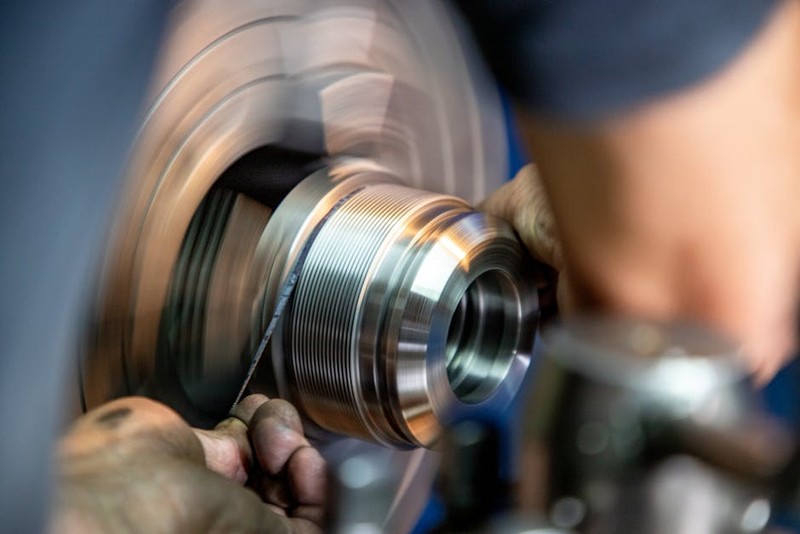
The Project: A luxury watch brand needed 300 identical, floor-standing display columns. Each was a three-part assembly: a heavy, turned stainless steel base, a slender anodized aluminum central shaft, and a titanium alloy top housing for the lighting electronics. The critical demand was that the three parts, when assembled, appear as a single, monolithic piece with no visible seam or misalignment.

The Hidden Complexity: The seamlessness wasn’t just about tight tolerances on the diameters. It was about:
1. Thermal Management: The internal LED generated heat, causing the aluminum shaft to expand at a different rate than the stainless steel.
2. Finish Consistency: The brushed finish had to flow uninterrupted across three different metals.
3. Assembly Load: The columns were assembled in a clean room in Switzerland, not our shop. Our interface designs had to be foolproof for their technicians.
Our Process and Solution:
1. Strategic Tolerance Stacking: We didn’t just tighten all tolerances. We used a compensated approach. The mating interfaces were held to ±0.0005″ (half a thou), while non-critical features were relaxed to improve manufacturability and cost.
2. In-Process Metrology: We didn’t wait for final inspection. Using an in-machine probe, we measured the critical interface diameters on every 10th part and adjusted tool offsets in real-time, creating a statistical process control (SPC) chart. This proactive approach caught a tool wear trend before it produced a single out-of-spec part.
3. Material-Specific Finishing: We developed a custom brush head and compound that could be applied to all three metals in the same fixture, ensuring the directional grain was perfectly aligned. The titanium required a slower RPM and lighter pressure to avoid smearing.
4. Foolproof Interface Design: We replaced a simple press-fit with a dual-diameter interface with a slight lead-in chamfer and a hidden elastomeric o-ring. This allowed for thermal expansion while maintaining visual seamlessness and provided tactile feedback to the assembler (“click”).
The Quantifiable Outcome:
The results were measured not just in microns, but in time and brand value.
| Metric | Project Goal | Outcome Achieved | Impact |
| :— | :— | :— | :— |
| Seam Visibility Gap | < 0.001″ (undetectable) | 0.0007″ average | Perfect visual continuity achieved |
| Assembly Time per Unit | Under 5 minutes | 3.2 minutes | Reduced client’s labor cost by 36% |
| First-Pass Yield | 95% | 99.7% | Near-zero waste, no rework delays |
| Post-Installation Callbacks | Zero | Zero (over 3 years) | Enhanced brand reputation for quality |
The client reported that the flawless presentation of their timepieces on these columns directly contributed to a perceived value increase, supporting a higher average transaction price in that location.
Expert Strategies for Success: Your Actionable Playbook
Based on lessons from this and similar projects, here is your actionable guide to mastering custom CNC turning for high-end retail components.
⚙️ 1. Master the “First Article” Ritual
The first part off the machine is not for shipping; it’s for destruction. Cut it, section it, measure its internal stresses, and test its finish under real lighting. In one case, this revealed that a specified anodizing process was creating a sub-surface etch that weakened a thin-walled section. We switched to a Type II hard coat anodize, solving the issue before producing 500 defective parts.
⚙️ 2. Design for the Finish, Not Just the Function
Always machine a “witness sample”—a small coupon of the actual material—and apply the full finishing process to it before committing the program. Submit this to the client for approval under their lighting. This simple step eliminates 90% of finish-related disputes.
💡 3. Embrace Hybrid Manufacturing
Don’t be a purist. The finest surface often comes from combining CNC turning with secondary processes. For example:
Turn a component to within 0.001″ of its final dimension.
Hand-polish or micro-blast to achieve the desired tactile quality (removing machine lines).
Use vibratory finishing with precise ceramic media for consistent edge-breaking on hundreds of small components.
💡 4. Quantify the “Feel”
Work with your client to create a physical “Gold Standard” sample. This master part, signed off by both engineering and design, sits in the quality lab. Every production run is compared to it not just with calipers, but by the lead technician’s hands. Human tactile sensitivity can detect variations that some machines miss.
The Future is Sensory-Integrated Manufacturing
The trajectory for custom CNC turning in this space is moving beyond static components. We are now integrating embedded sensors, RFID tags, and even dynamic lighting elements into turned metal housings. The next challenge is turning a solid block of aluminum into a seamless shell that hides wireless charging coils or touch-sensitive interfaces without a single visible seam or button.
The ultimate lesson? In high-end retail, you are not machining a component; you are machining a customer’s perception of quality, luxury, and brand integrity. Every revolution of the spindle, every choice of insert geometry, and every post-processing decision must be made with that end experience in mind. By focusing on the unseen details—the micro-finish, the thermal fit, the sensory spec—you transform CNC turning from a cost center into a powerful brand-enhancing tool. The goal is to make the engineering invisible, so only the artistry and perfection remain.